2024–2025
Fountain Life
How a 6-month UX research and redesign engagement transformed Peter Diamandis’s longevity health platform
Healthcare
Enterprise UX
Research-to-Launch
Longevity Platform
AI Integration
Summary
Fountain Life is a precision health and longevity platform co-founded by Peter Diamandis and Tony Robbins, with centers across the U.S. offering advanced diagnostics, AI-driven health insights, and concierge-level care for high-net-worth members. Memberships range from $10,500 to six figures. The company’s digital presence wasn’t matching the caliber of its clinical offering.
Over a 6-month engagement at CreateApe, I worked closely with a UX Director to research, design, and ship a complete redesign of Fountain Life’s website. I owned the hands-on UX research and design execution, conducting the heuristic evaluation, brand analysis, competitor audit, Google Analytics review, accessibility check, user surveys, persona development, and sitemap restructuring. The UX Director provided strategic oversight, guided client-facing decisions, and helped shape the overall design direction. Together, we delivered a comprehensive redesign strategy and brought it to life.
The result: a research-backed redesign addressing 6 core findings, now live at fountainlife.com, transforming a text-heavy, trust-deficient site into a premium digital experience with visible pricing, trust signals, member testimonials, AI-powered features, and a clear conversion architecture across 3 membership tiers.
Role
UX Designer & Researcher
Tools
Figma
Google Analytics
Hotjar
SurveyMonkey
Team
1 UX Director
1 UX Designer (me)
1 Project Manager
1 Dev Lead
Client Stakeholders
Duration
6 months
Work completed as part of the CreateApe design team. Some details have been simplified due to confidentiality agreements. All trademarks and data belong to their respective companies.
Summary
The Challenge
Fountain Life operates in a premium, high-trust category: longevity medicine for affluent, health-conscious individuals. The clinical offering is world-class advanced diagnostics, AI-powered health assessments, and access to leading physicians. But the website wasn’t communicating that value.
The existing site was text-heavy, lacked social proof, buried critical information like pricing and FAQs, and didn’t reflect the brand’s premium positioning. For a platform where memberships start at $10,500, the digital experience needed to match the in-person one. It didn’t.
Analytics, heuristic evaluation, and user surveys revealed three critical friction points:
Low Engagement
0s
0s
Average time on site for new users. For a platform requiring a multi-thousand-dollar commitment, users weren’t finding enough to stay.
Zero Trust Signals
0
0
Testimonials, reviews, or trust badges on the homepage. For a membership costing thousands, prospective members had nothing concrete to validate the investment.
Information Gaps
0%
0%
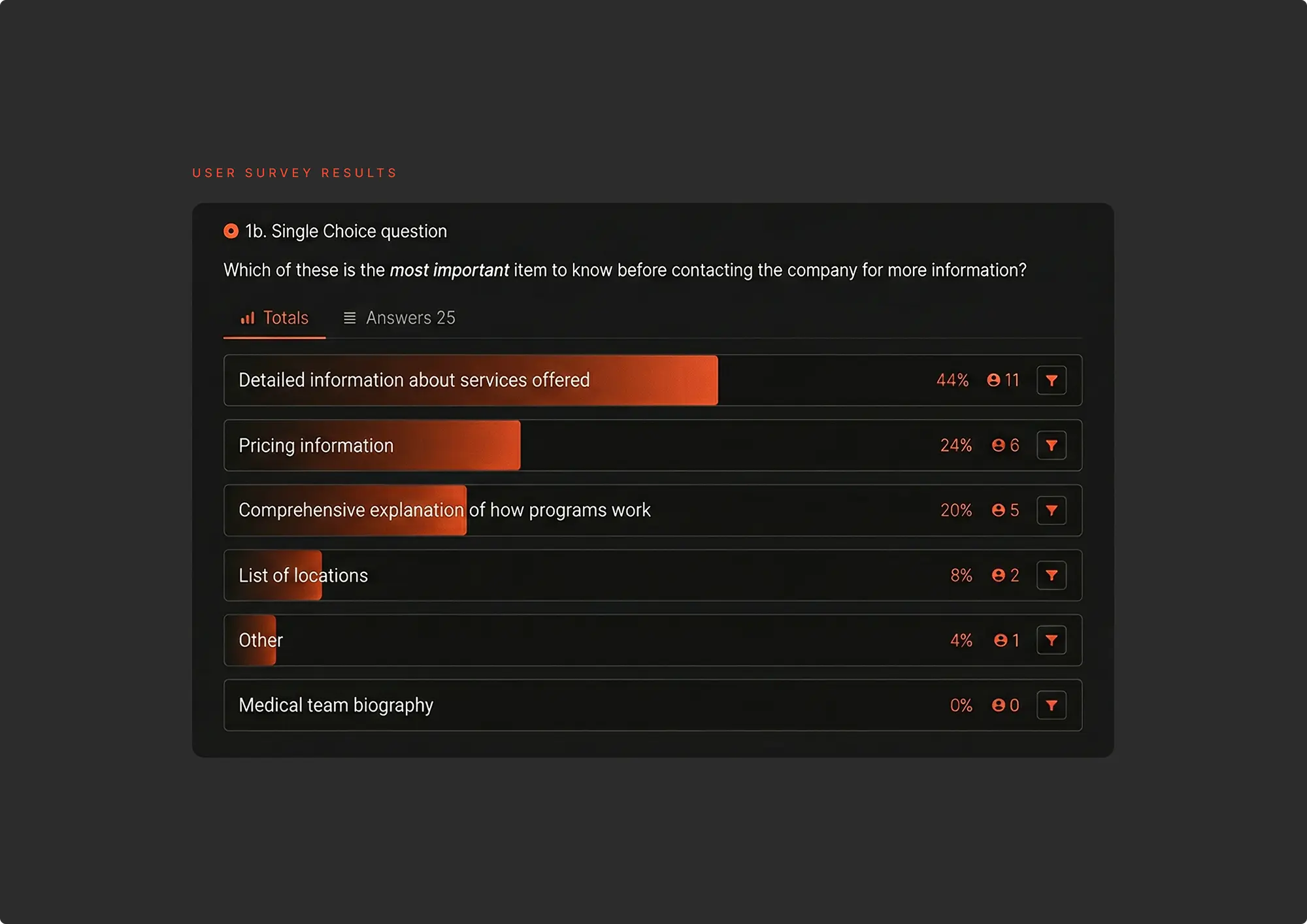
of surveyed users said detailed service information was the most important factor before contacting the company. 24% wanted pricing. The site provided neither.

“We’re reshaping the minds of people and trying to inspire people to think about healthcare in a different way.”
— Internal Stakeholder
The Challenge
Research Methodology
The first phase of the engagement focused on systematic research. Over several weeks, I conducted the hands-on research execution while collaborating with the UX Director on approach, scope, and how findings would inform the redesign strategy. Fountain Life’s audience, affluent individuals aged 50–70, has specific expectations for digital experiences, and we knew assumptions without data would lead to the wrong redesign.
0
0
Research Deliverables
0
0
Survey Respondents
0
0
Core Findings
Heuristic Evaluation
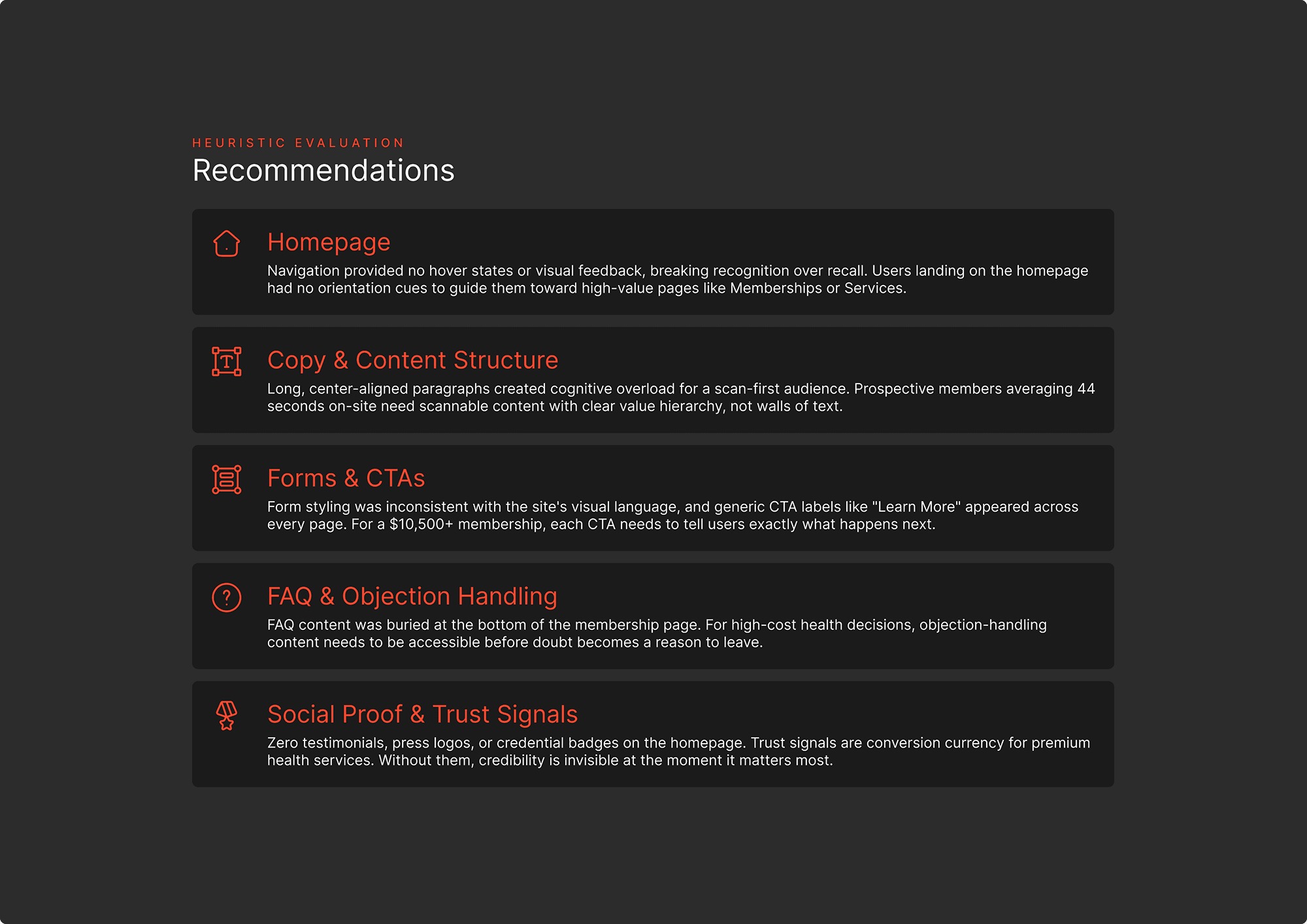
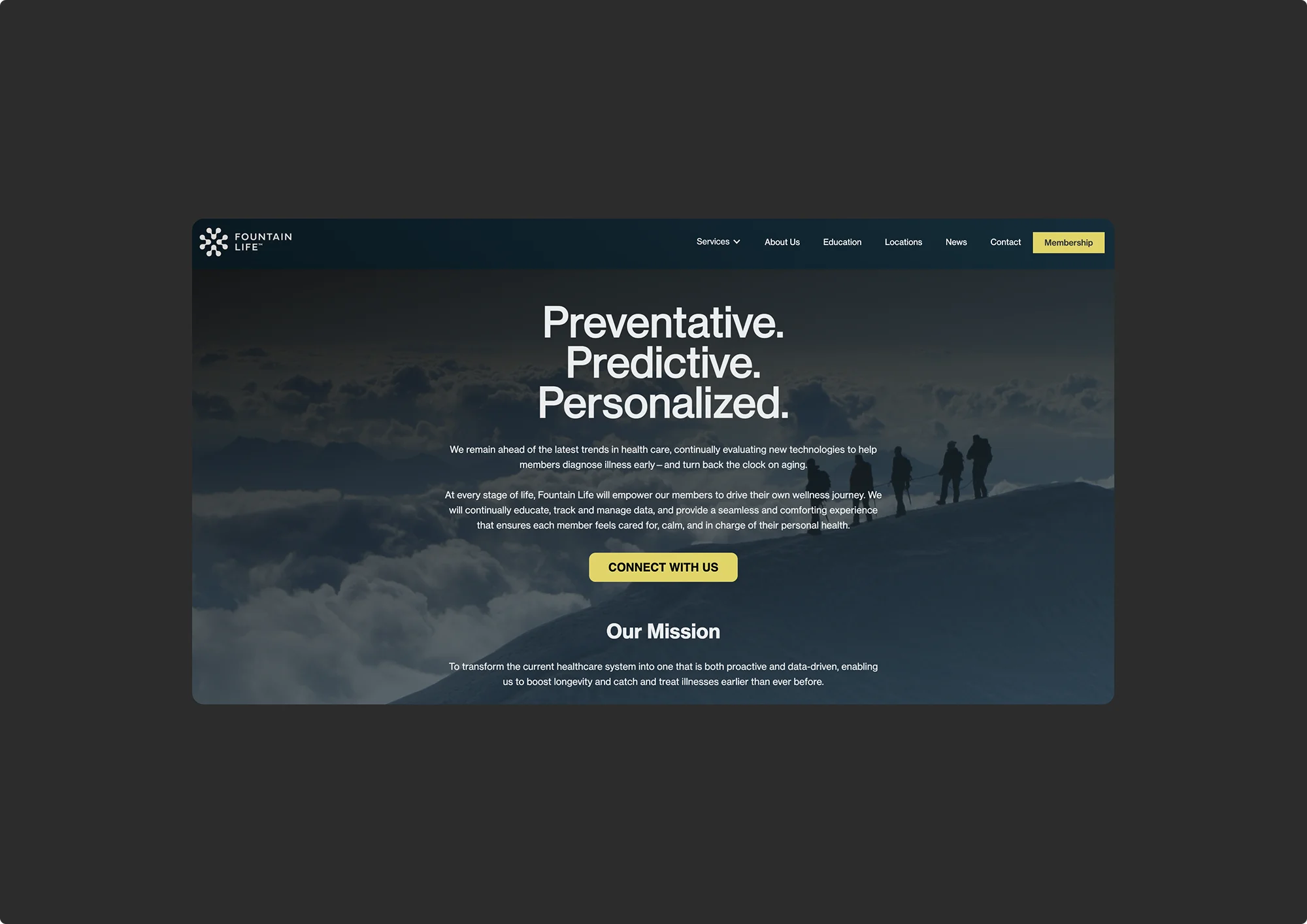
I conducted a systematic heuristic evaluation against Nielsen’s 10 usability heuristics, reviewing the full site across usability, UI design, and UX patterns. Key findings: vague CTA language (“Learn More” instead of action-specific verbs), no search functionality, excessive text blocks without progressive disclosure, inconsistent form styling, buried FAQ content, no visible pricing, and minimal social proof.
Brand Analysis
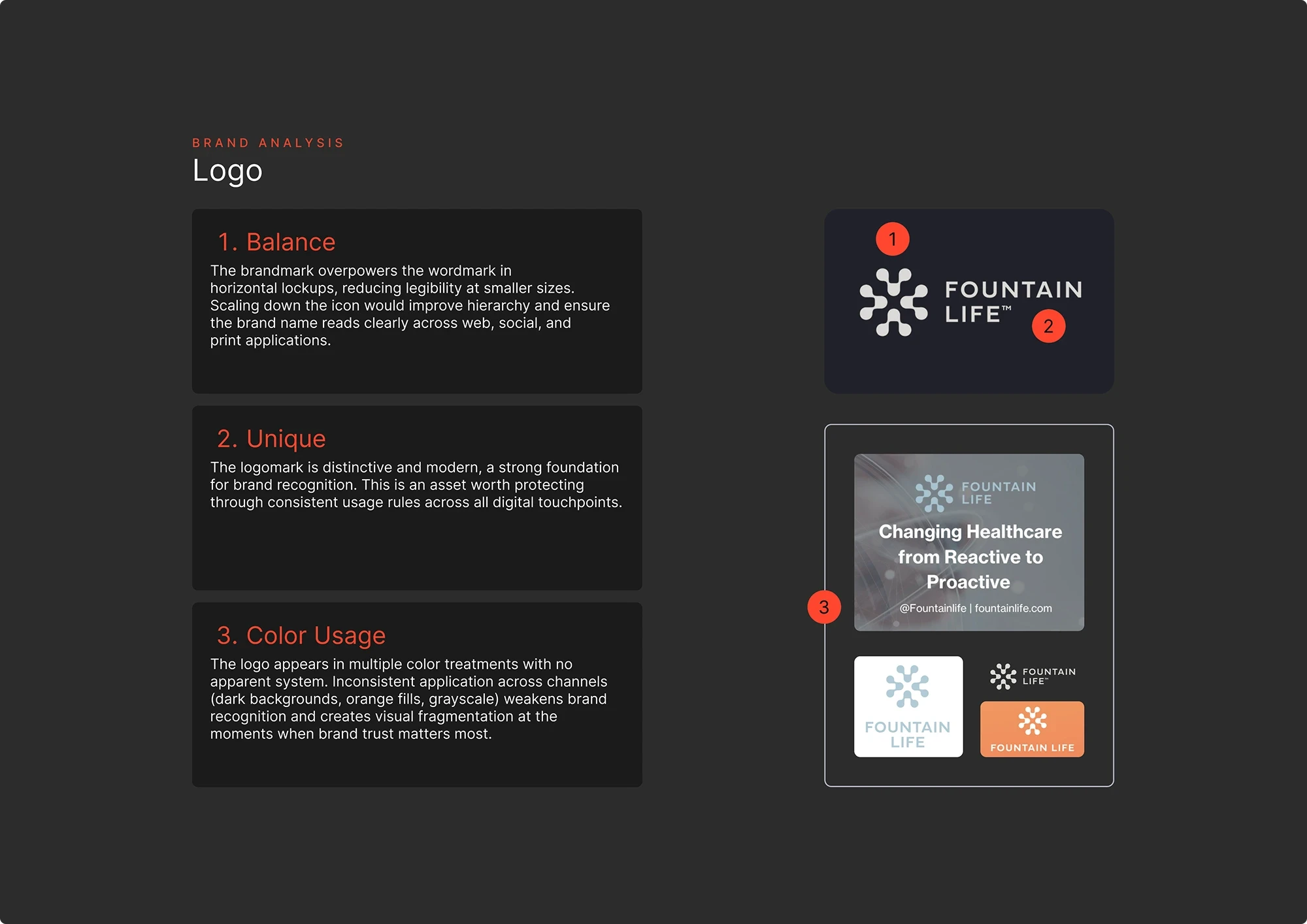
I analyzed Fountain Life’s brand positioning, visual identity, and messaging consistency across the website. The brand had strong clinical credibility (co-founded by Peter Diamandis and Tony Robbins) but the website’s visual language, generic stock imagery, inconsistent color application, clinical layouts, didn’t reflect the premium, aspirational positioning that the in-person experience delivered.
Competitor Analysis
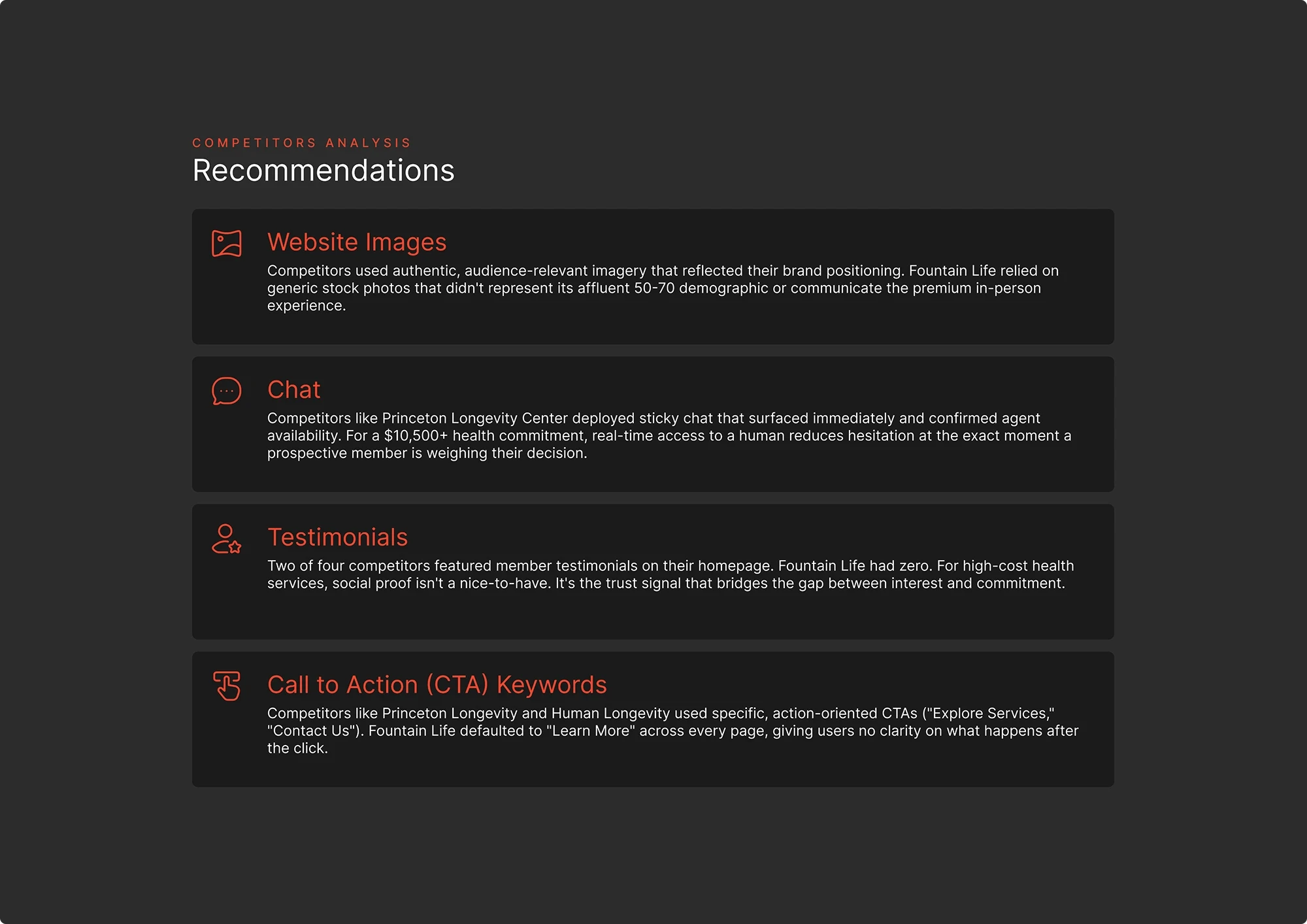
I benchmarked Fountain Life against four direct competitors in the longevity and precision health space. Key learnings: competitors with homepage testimonials built higher trust; competitors like Princeton Longevity Center had sticky chat; most used visual storytelling over text-heavy pages; CTA language was significantly more specific and action-oriented than Fountain Life’s generic “Learn More.”
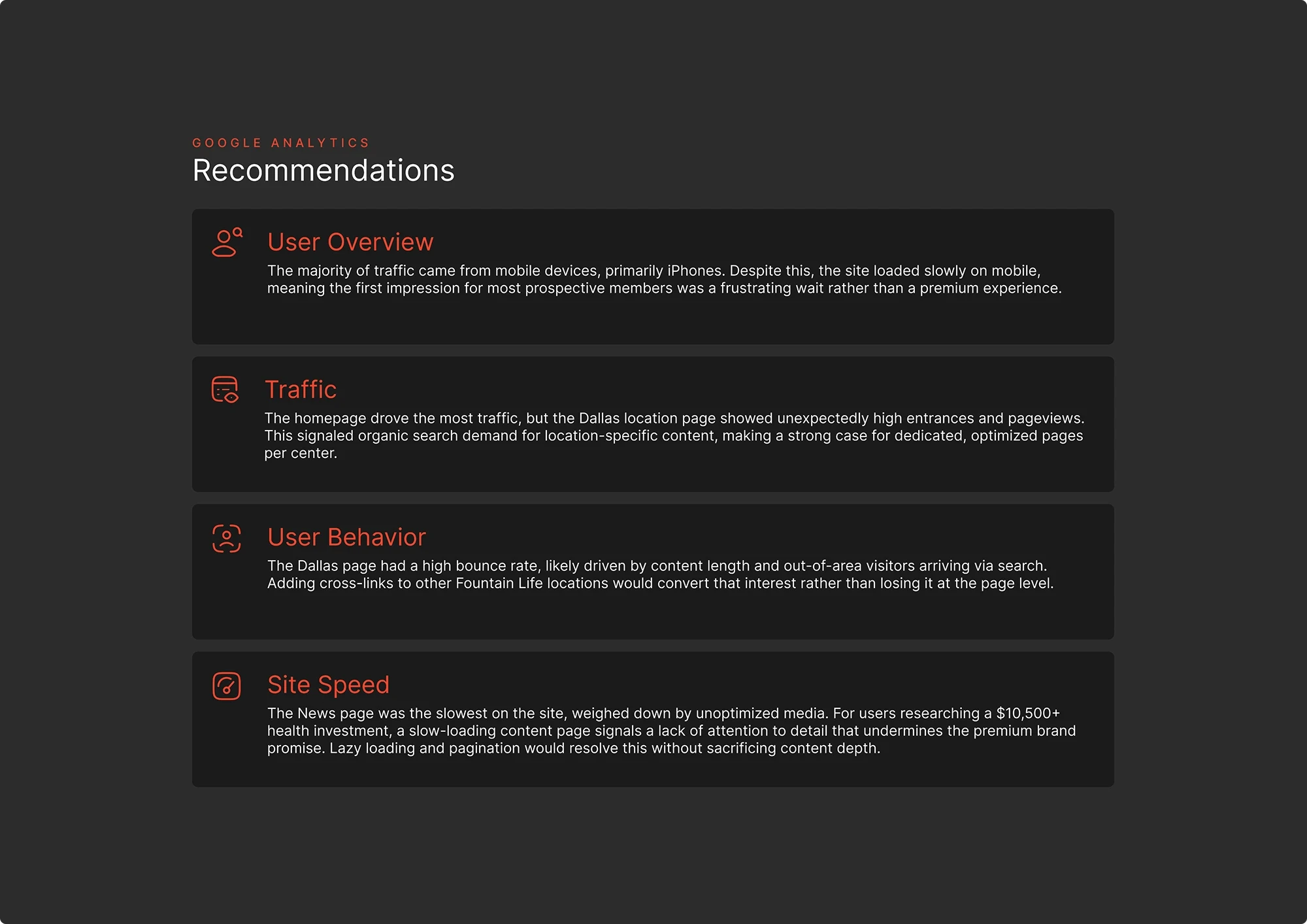
4. Google Analytics Review
I analyzed 3 months of behavioral data. Key insights: members primarily aged 50 – 70, traffic predominantly mobile (iPhone), acquisition via direct and paid search, Apex Membership page most visited, new user sessions averaging only 44 seconds, and a 4.4 site speed score indicating performance issues.
Accessibility Check
I ran an accessibility audit against WCAG guidelines identifying contrast issues, missing alt text, keyboard navigation gaps, and form labeling deficiencies. For a healthcare platform serving an older demographic, accessibility directly impacts whether the target audience can use the site.
6. User Surveys
I analyzed 3 months of behavioral data. Key insights: members primarily aged 50–70, traffic predominantly mobile (iPhone), acquisition via direct and paid search, Apex Membership page most visited, new user sessions averaging only 44 seconds, and a 4.4 site speed score indicating performance issues.
Personas & Journey Maps
From the research synthesis, I developed three primary personas:
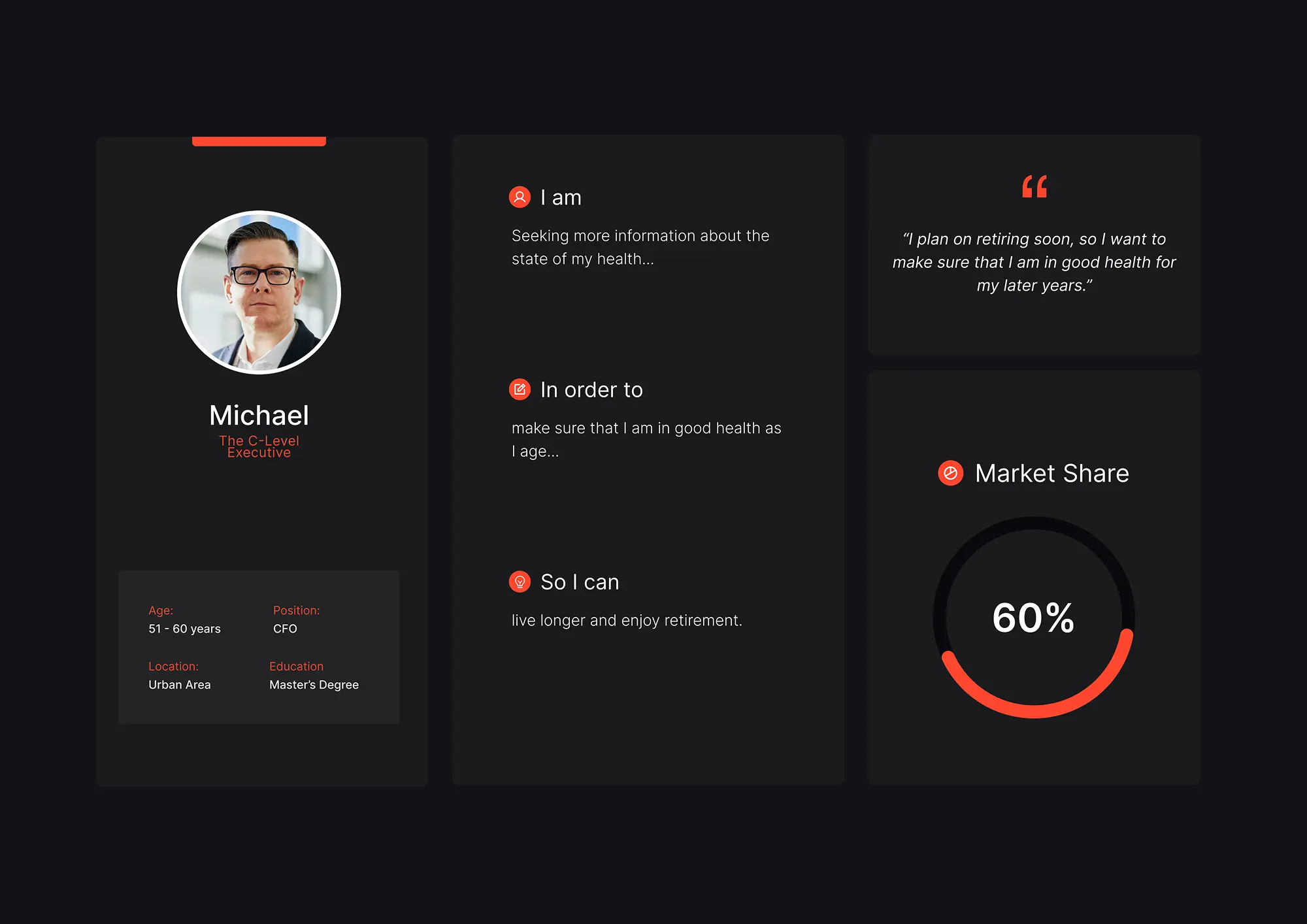
Michael - The C-Level Executive.
Age 51–60, CFO, Master’s degree. Seeking health information for retirement planning. 60% of the target market.
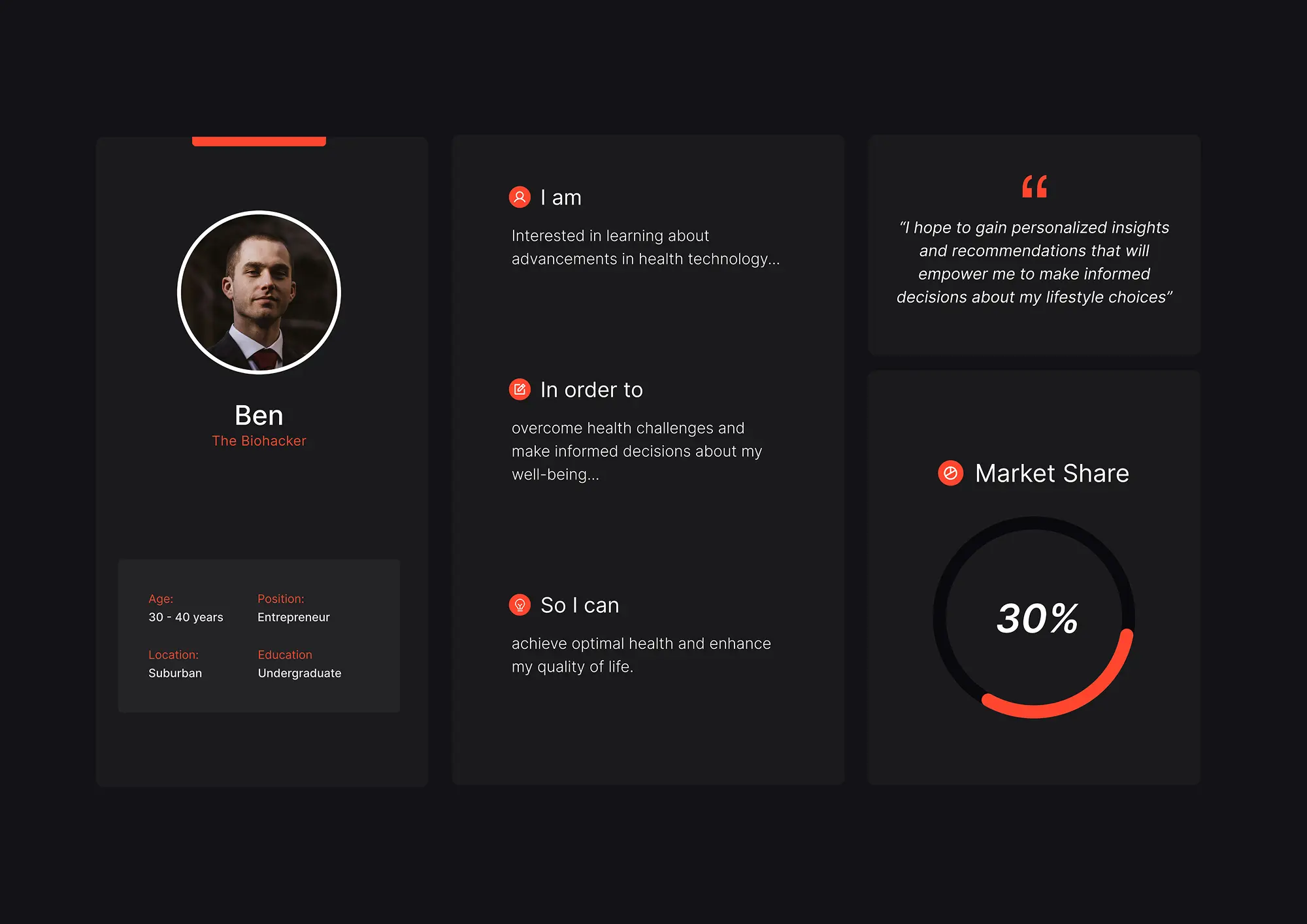
Ben - The Biohacker.
Age 30–40, entrepreneur. Interested in cutting-edge health technology. 30% of the target market.
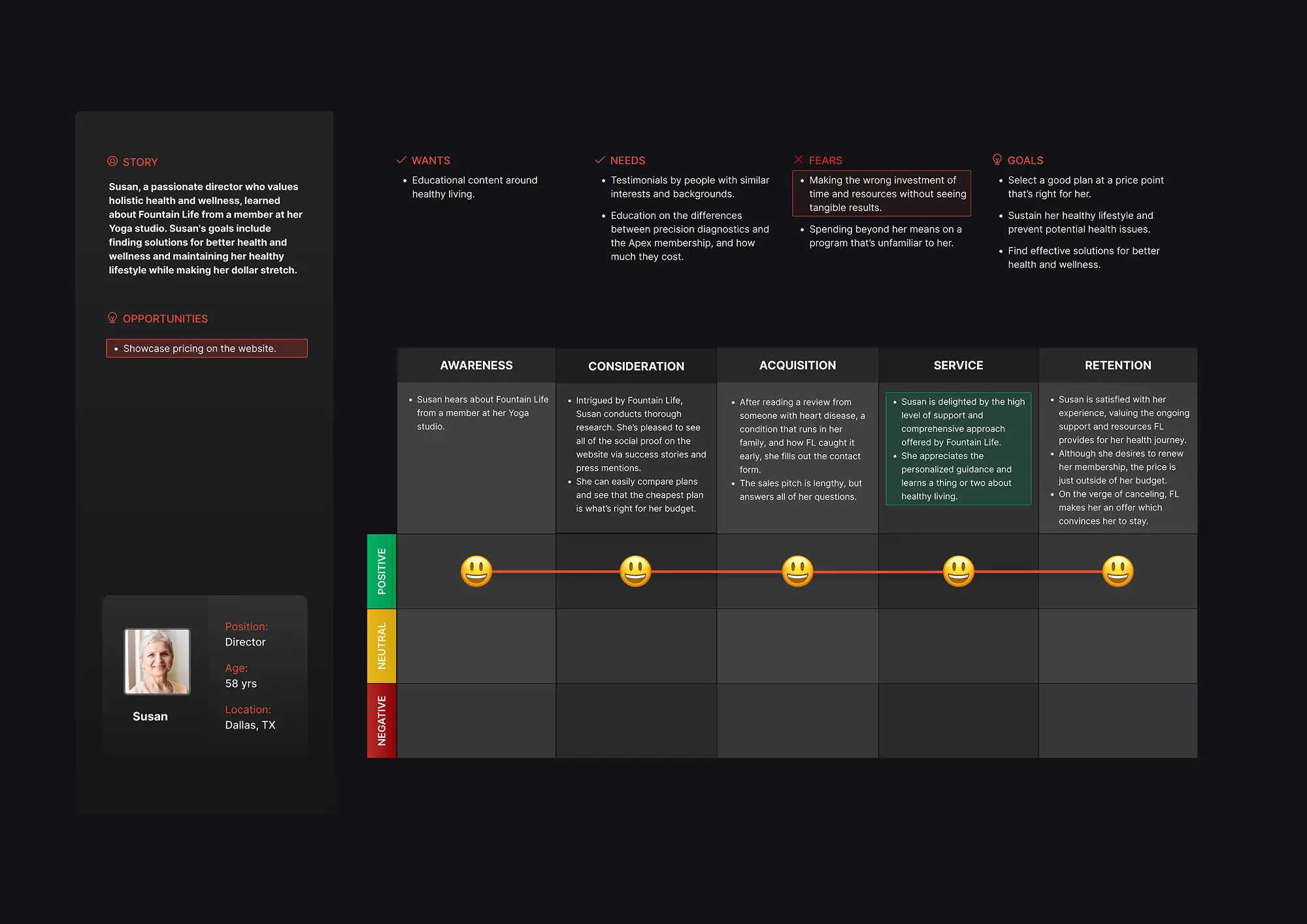
Susan - The Health-Conscious Director.
Age 58, Dallas. Values holistic wellness, budget-conscious despite affluence. 10% of the target market.
Each persona included a full journey map across Awareness → Consideration → Acquisition → Service → Retention, identifying emotional states, friction points, and opportunities at each stage.
How I Audited It
The Strategic Reframe
Seven deliverables, 25 survey responses, 3 months of analytics, and 22 stakeholder interviews all pointed to one conclusion that reframed the entire project:
“The website was selling a premium product with a generic experience.”
Fountain Life’s clinical offering was world-class. The founding team included Peter Diamandis and Tony Robbins. The diagnostic technology was cutting-edge. But the website communicated none of this differentiation. It read like a standard medical practice site, text-heavy, impersonal, and trust-deficient.
Users weren’t bouncing because they didn’t understand longevity medicine. They were bouncing because the site didn’t earn their trust fast enough to justify a membership that starts at $10,500.
This insight, which I surfaced through the research and brought to the team, changed our approach. We stopped fixing individual pages and started redesigning around a different question:
“How do we make a $10,000+ health membership feel like the obvious next step within a single website visit?”
The answer was first-session success: can a visitor understand what Fountain Life offers, trust it’s credible, and feel confident enough to take action, all within a single visit? The UX Director and I aligned on this framing, and every design decision that followed was an answer to that question.
The Strategic Reframe
The Redesign
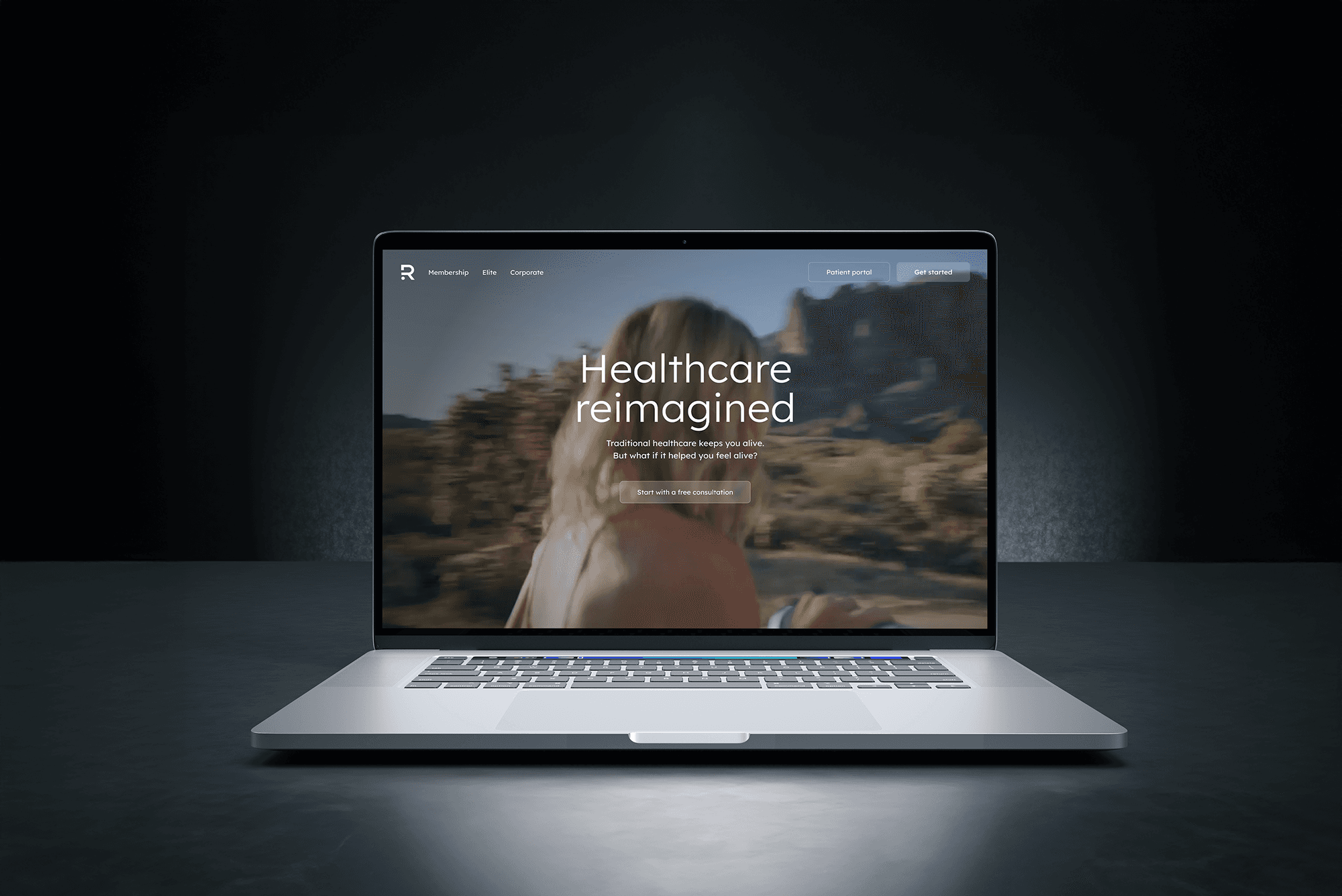
With the trust reframe as our lens, the team designed solutions for each of the 6 core findings. I owned the design execution, translating research findings into wireframes, prototypes, and high-fidelity screens, while collaborating with the UX Director on design direction and stakeholder alignment. The redesign is now live at fountainlife.com.
From Wall of Text to Visual Storytelling
What we found:
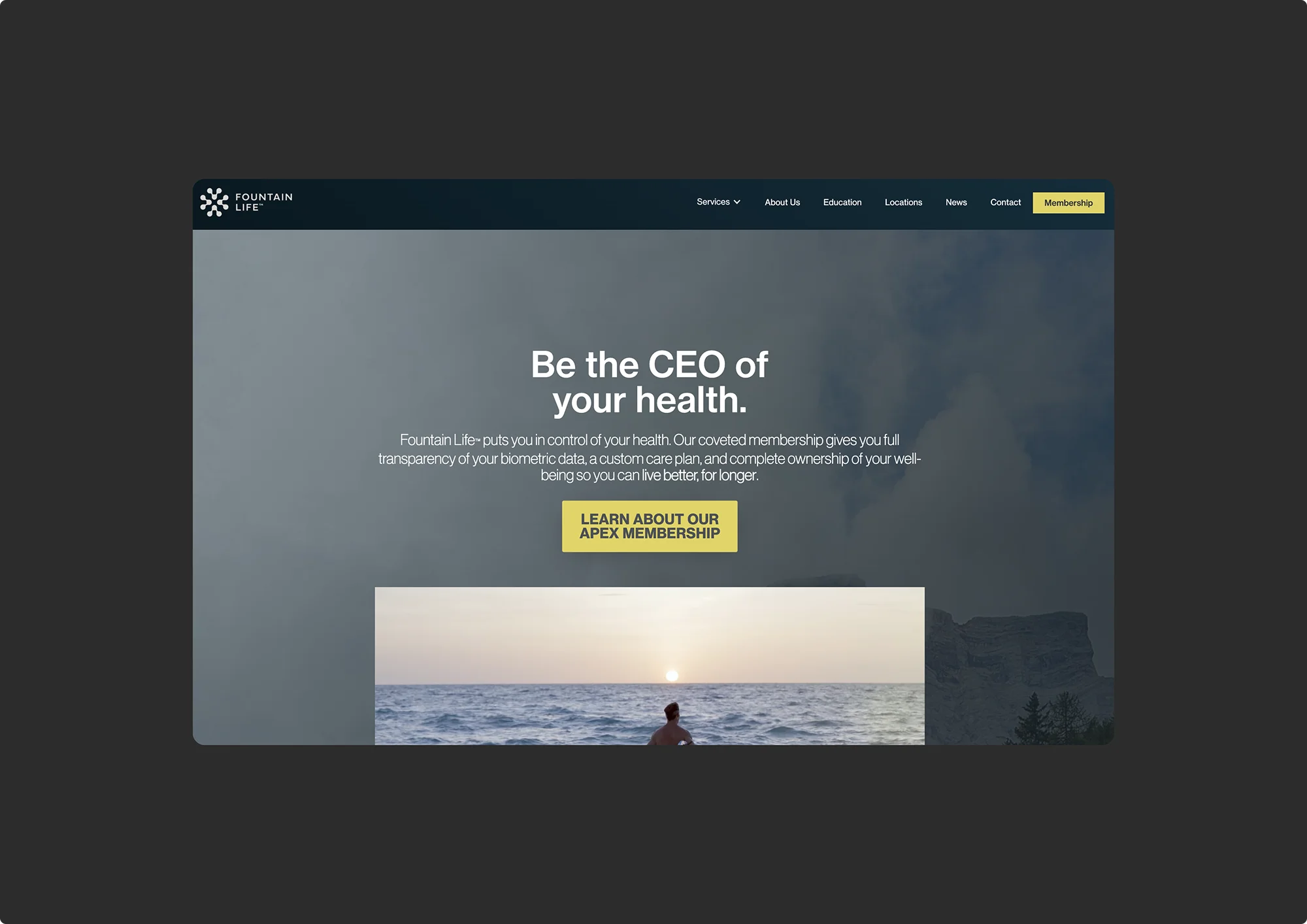
Pages were text-heavy with long paragraphs, center-aligned copy, and no visual hierarchy. New users spent 44 seconds on the site. 83% of stakeholders wanted relevant visuals incorporated.
What we designed:
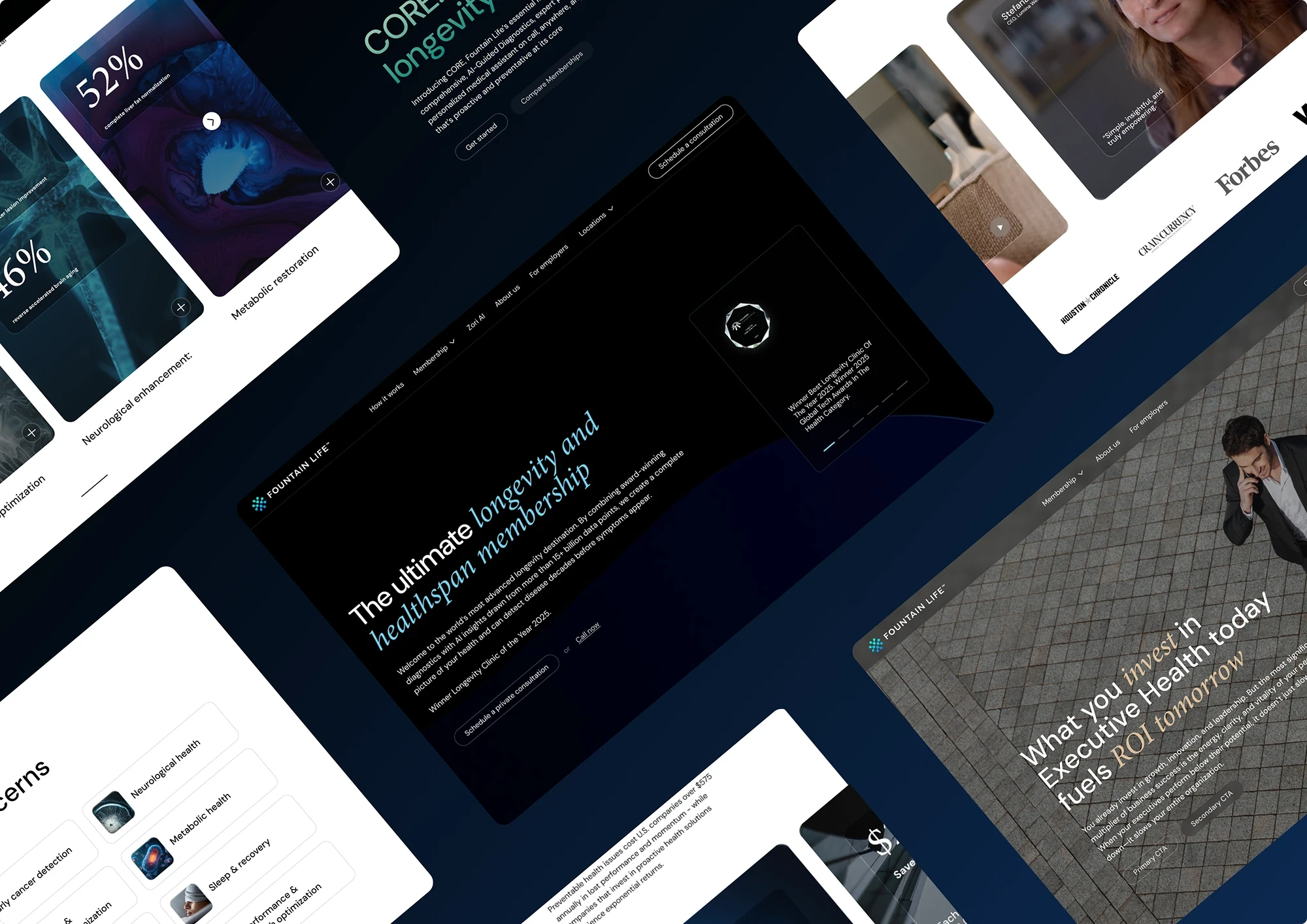
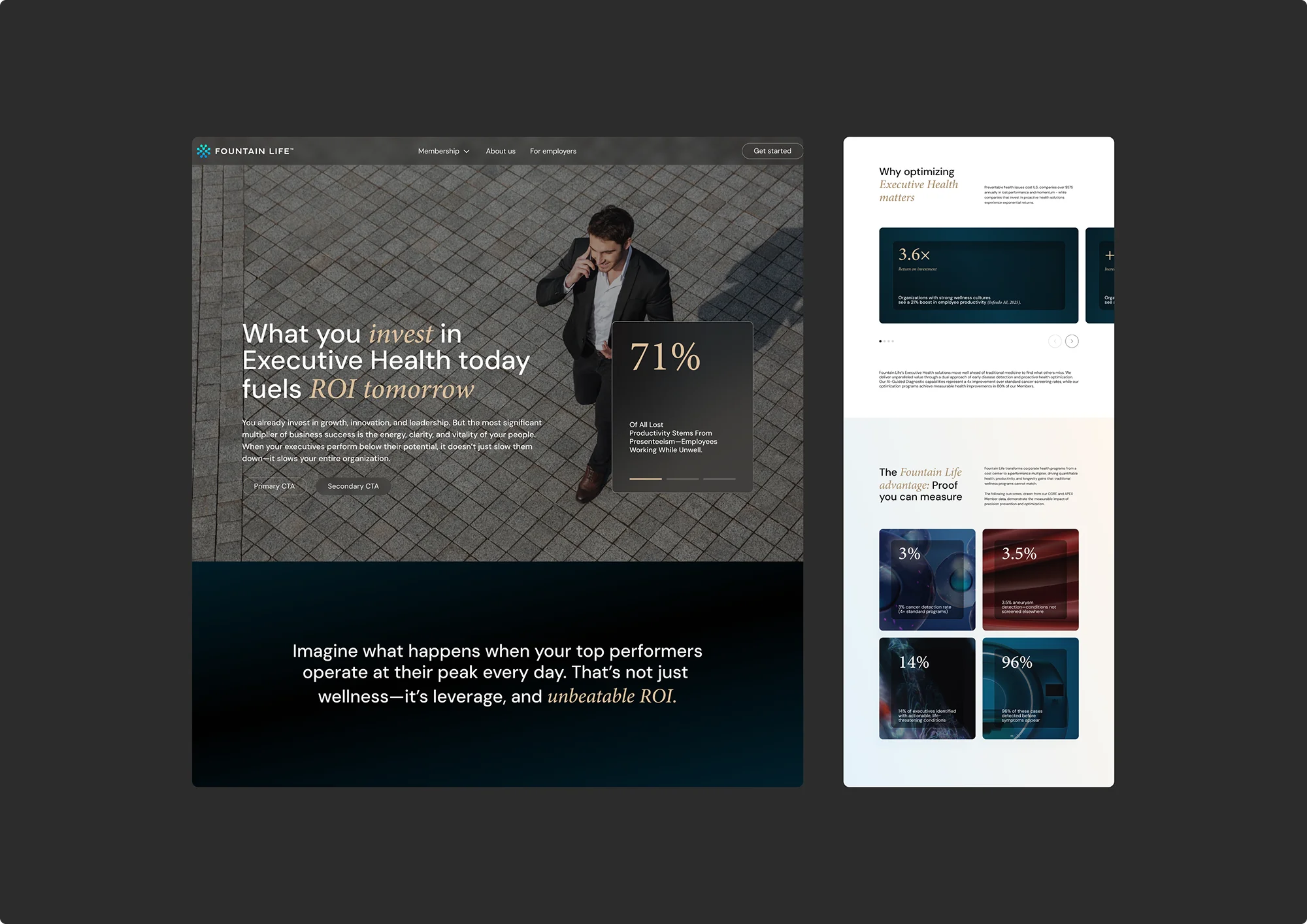
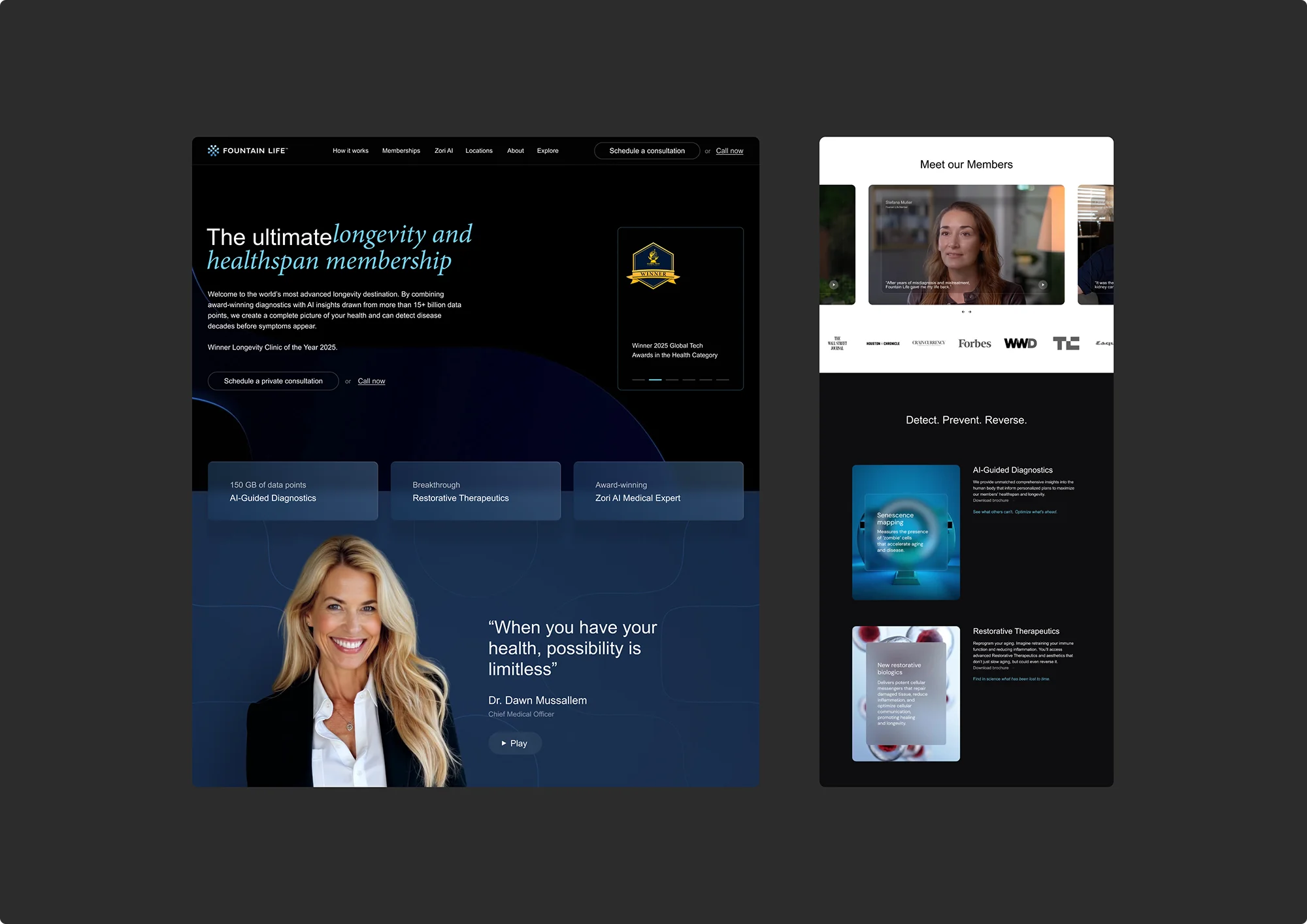
The live site now uses scannable content architecture throughout. The homepage leads with “The ultimate longevity and healthspan membership” in clear hierarchy, followed by three feature pillars (AI-Guided Diagnostics, Restorative Therapeutics, Zori AI Medical Expert) with visual cards instead of text blocks. Each membership tier page (CORE, APEX, EPIC) uses the same scannable structure: bold hero statement with a key stat, visual feature breakdown, and comparison table.
The Executive Health page is the clearest example:
data visualizations (3.6x ROI, 3% cancer detection rate, 96% pre-symptom detection), a comparison table against standard programs, and progressive disclosure for financial impact data. Every number earns its space.
Before
After
From Generic Stock to Premium Brand Experience
What we found:
Pages were text-heavy with long paragraphs, center-aligned copy, and no visual hierarchy. New users spent 44 seconds on the site. 83% of stakeholders wanted relevant visuals incorporated.
What we designed:
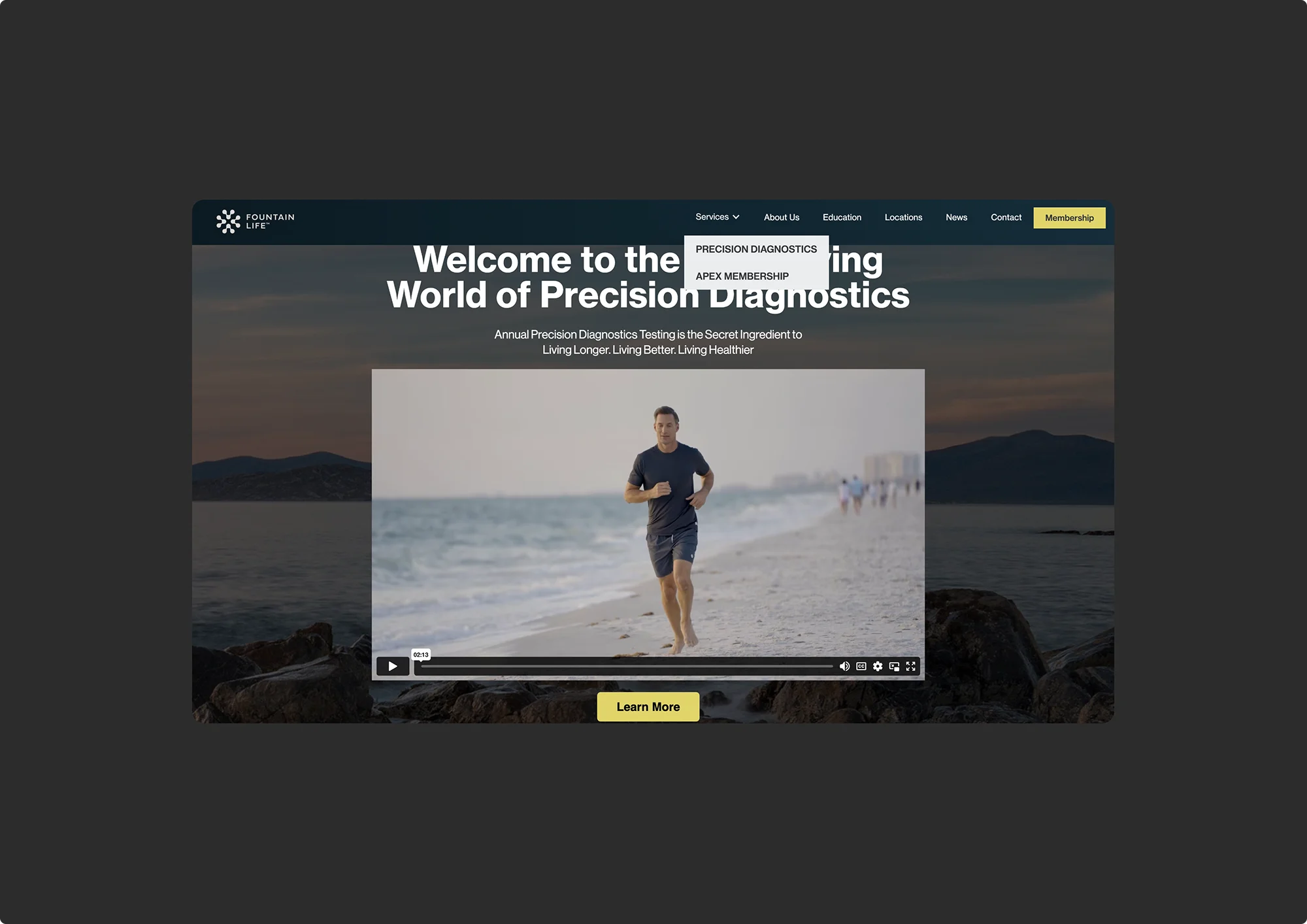
The live site uses a cohesive dark visual language with deep navy and teal gradients that communicate both medical precision and premium positioning. Real facility photography, cellular-level scientific imagery, and custom illustrations replace every stock photo. The membership tier pages use distinct color treatments, teal for CORE, blue for APEX, and rose-gold for EPIC, creating immediate visual differentiation. The homepage hero features real photography of a Fountain Life physician with a CMO video quote, making the experience feel personal and premium from the first second.
Before
After
From Clinical and Impersonal to Human-Centered
What we found:
No patient stories, no human element in the primary user flow. The About Us page showed founding partners but didn’t connect emotionally.
What we designed:
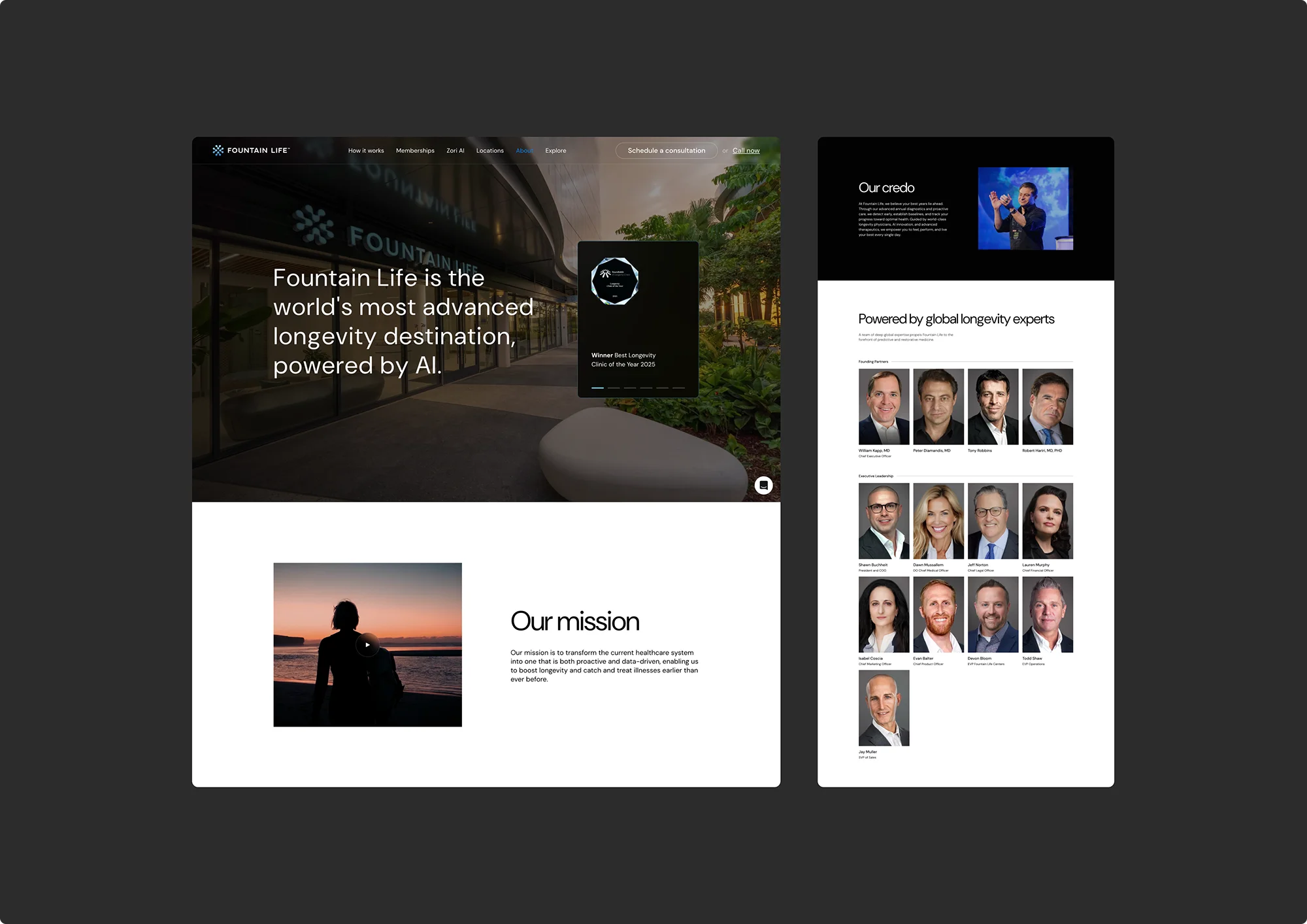
The live site now has “Meet our Members” carousels on the homepage and every membership page, featuring real patients with named stories. The CMO Dr. Dawn Mussallem appears with a video quote on the homepage. The About page shows the full medical advisory team with photos, titles, and credentials. Peter Diamandis has a personal video testimonial. The Executive Health page includes a named business leader testimonial.
Before
After
From Information Desert to Self-Serve Education
What we found:
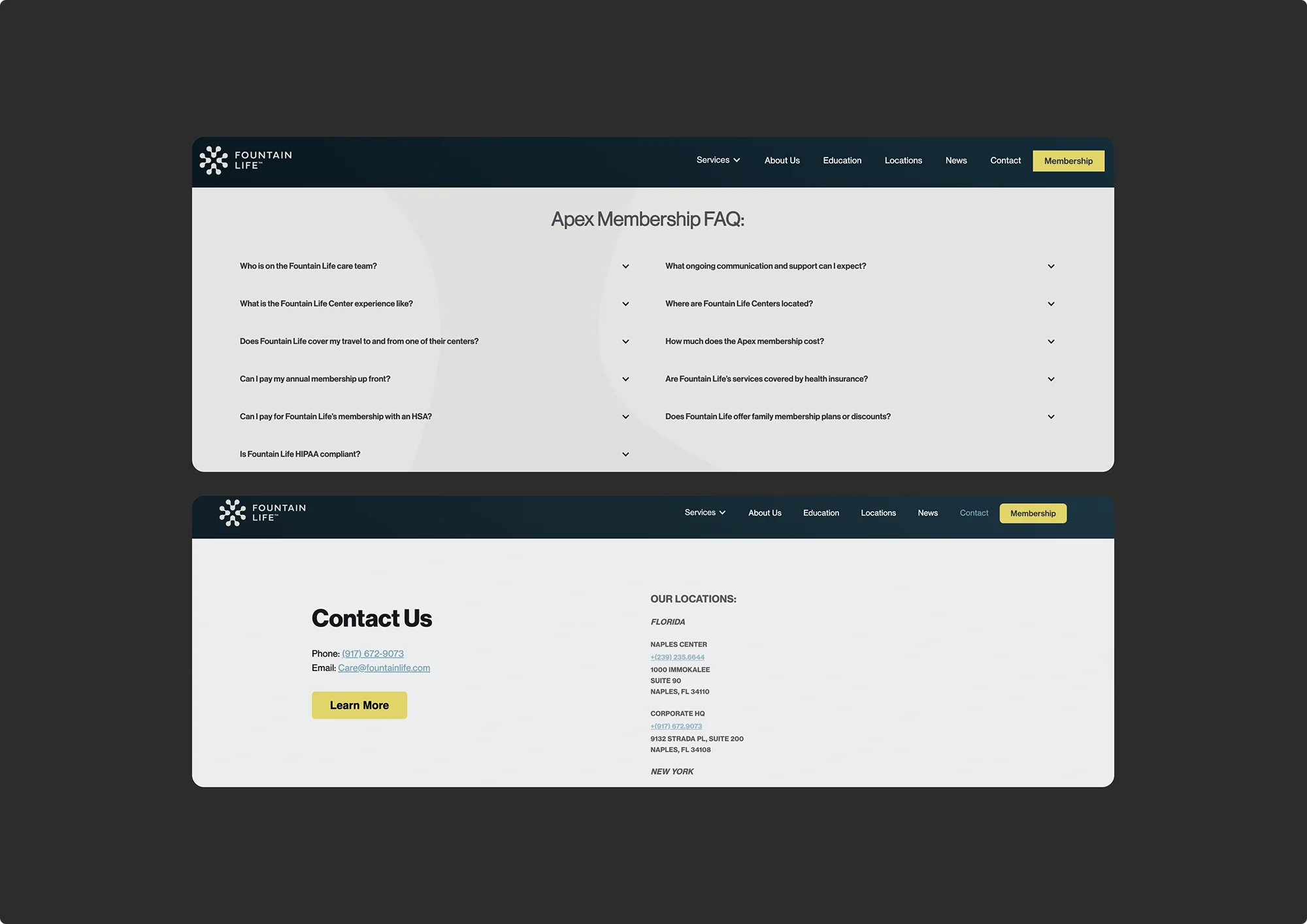
44% of users wanted detailed service info. 24% wanted pricing. FAQ buried at the bottom. No educational resources.
What we designed:
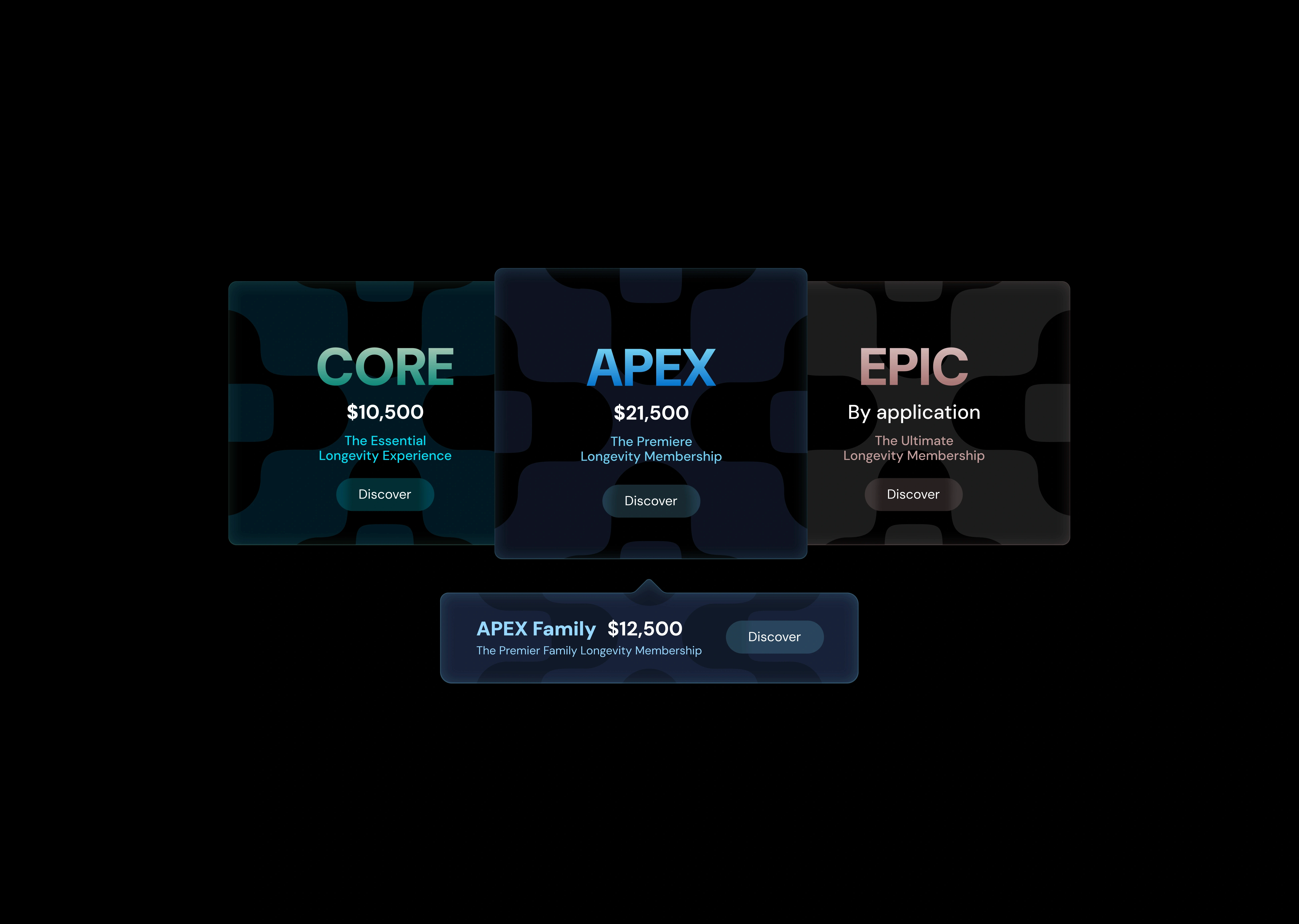
A dedicated Health Concerns page covering 12 conditions. A dedicated Zori AI page explaining the AI Medical Expert. An “Addressable health concerns” section on the homepage with visual cards. Each membership page includes downloadable brochures. A “How it works” section in the navigation. And critically: pricing is now visible, CORE at $10,500, APEX at $21,500, EPIC by application, with a comparison table on the memberships page.
Before
After
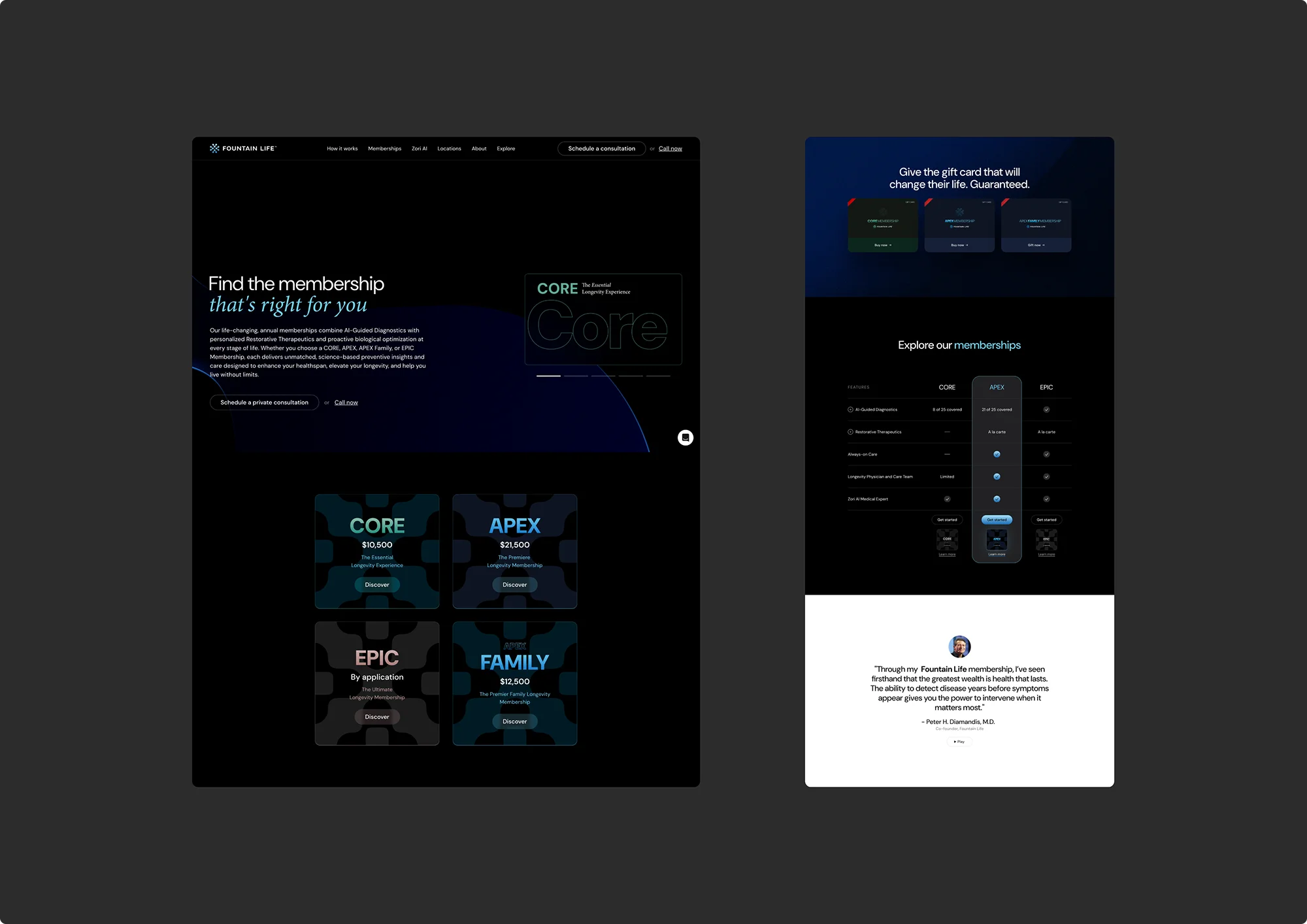
From Trust Vacuum to Credibility Architecture
What we found:
Zero testimonials, reviews, or social proof on the homepage. No press logos. No certification badges. No outcome data.
What we designed:
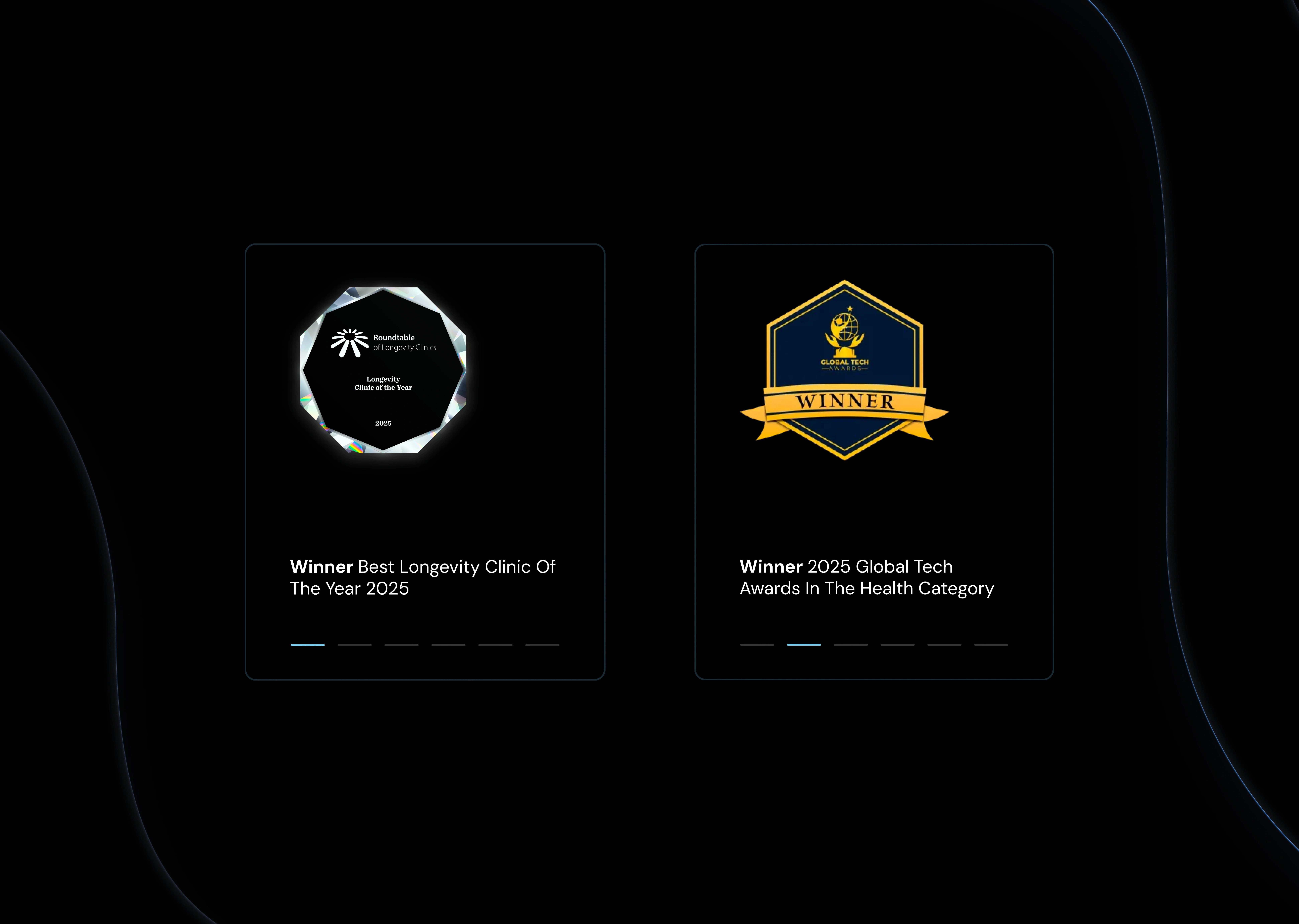
A comprehensive trust architecture. The homepage features: a “Winner Best Longevity Clinic of the Year 2025” badge, a “Winner 2025 Global Tech Awards in the Health Category” badge, a press logo bar (Forbes, TechCrunch, WWD, Esquire, Beauty Matter, Wall Street Journal), member testimonial carousel, and outcome statistics (96% pre-symptom detection, 80% measurable health improvements). Every membership page includes award badges and member stories. The Executive Health page shows specific ROI data: 4x better cancer detection, 13:1 ROI.
Before
After
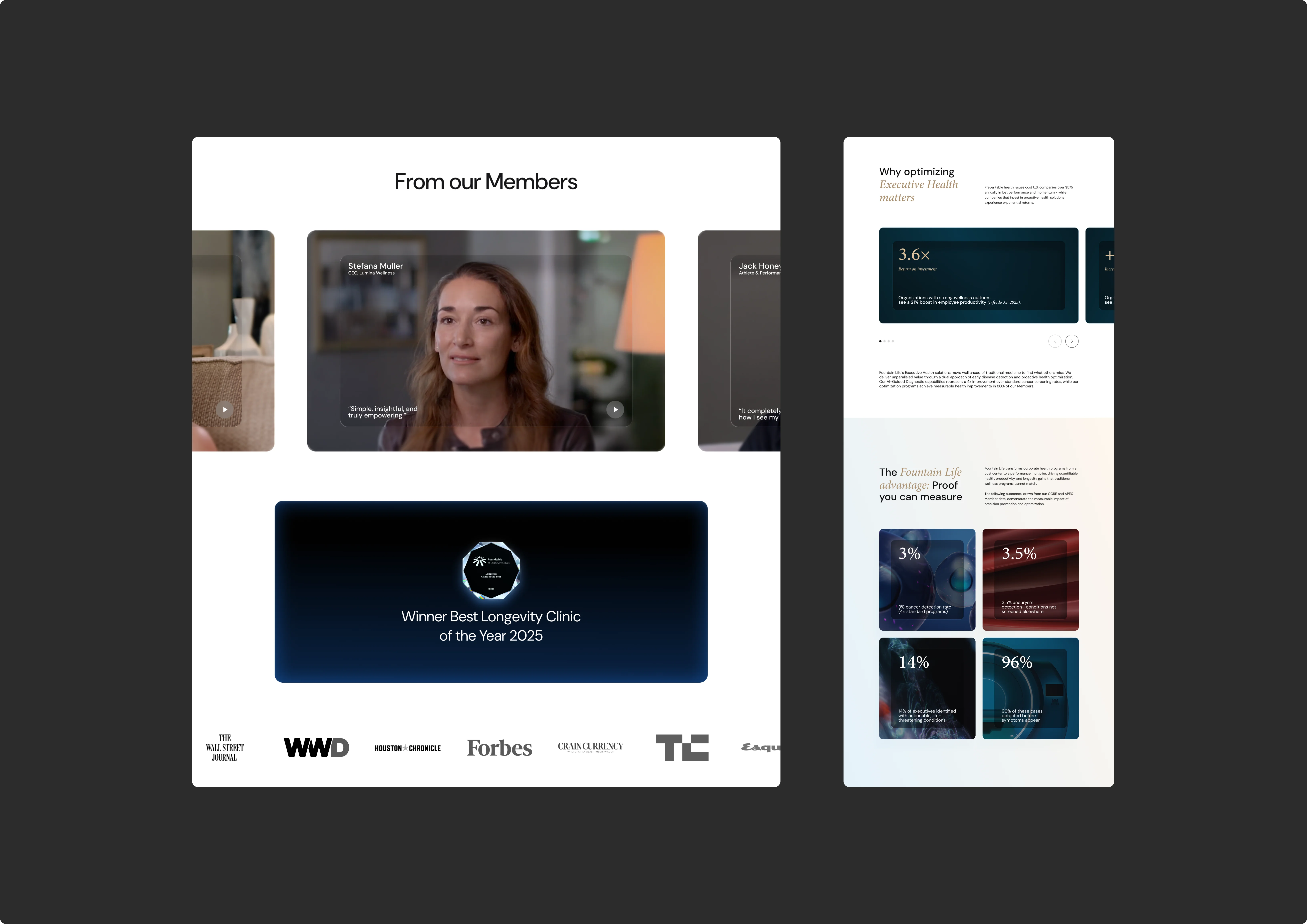
From Static Website to Intelligent Health Platform
What we found:
No member portal, no self-serve options, no digital touchpoint between visits.
What we designed:
This finding contributed to the development of Zori AI Medical Expert, an award-winning AI health assistant integrated into the Fountain Life app. Zori AI analyzes members’ biomarkers, imaging data, genetics, and daily health inputs to provide personalized guidance. It offers precision nutrition, travel intelligence, continuous health tracking, and wearable integration. Zori AI won the 2025 Global Tech Awards in HealthTech. A dedicated page on the website explains the full capability. What started as a research recommendation for a “members portal” became something far more ambitious.
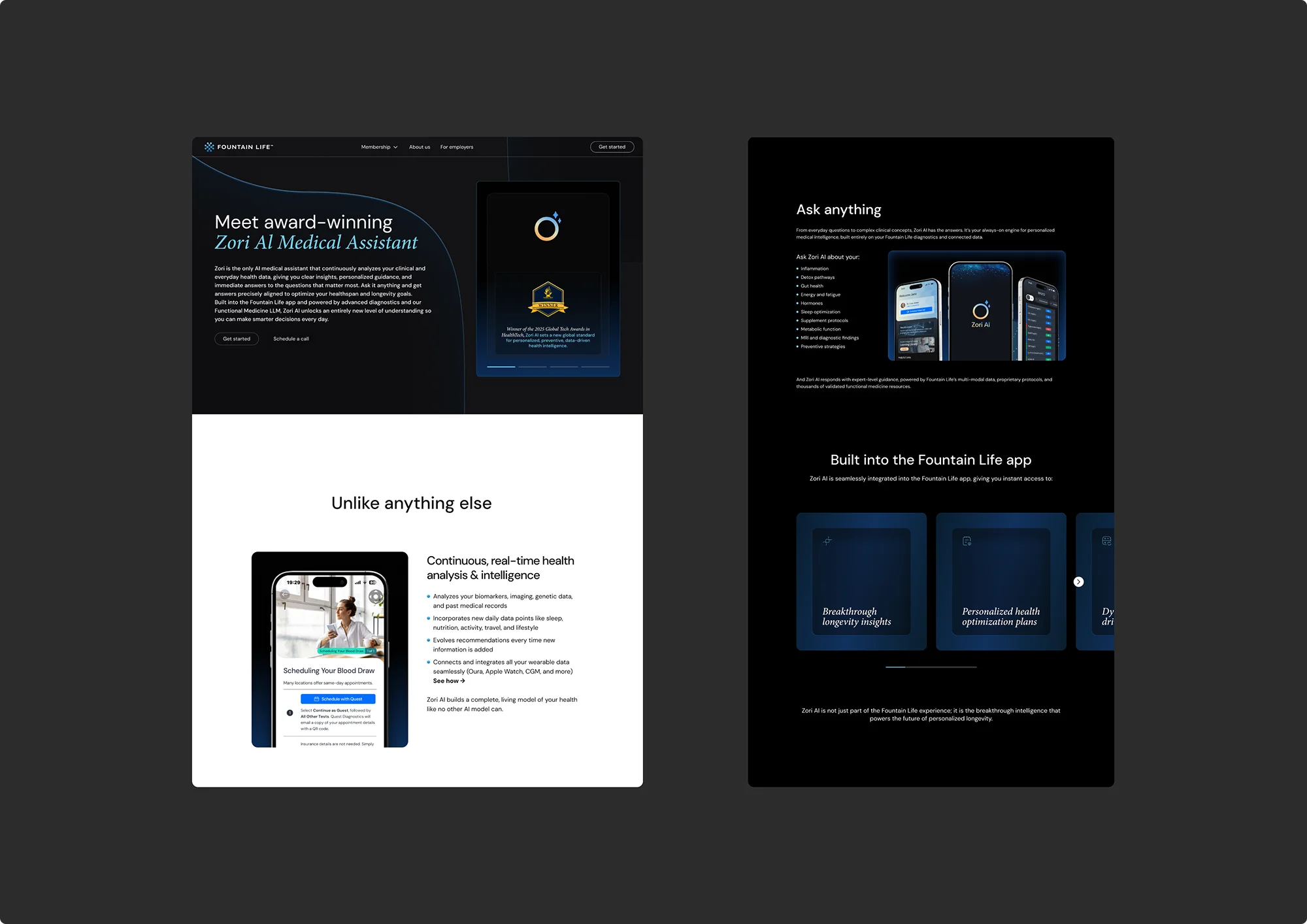
The Redesign
The First-Session Success Lens
Every finding in this audit traces back to one principle:
Can a prospective member understand what Fountain Life offers, trust it’s credible, and feel confident enough to schedule a consultation, all within a single website visit?
That’s first-session success. And for a platform where the entry-level membership is $10,500, the stakes are higher than most products.
The scannable content serves it: users understand the value faster. The premium visuals serve it: the brand’s positioning becomes immediate. The member stories serve it: prospective members see themselves in the narrative. The resources serve it: objections are answered before they become reasons to leave. The trust signals serve it: credibility is visible before commitment is asked for. The Zori AI page serves it: the product’s innovation is demonstrated, not just described.
First-session success isn’t a checklist. It’s a design lens. And Fountain Life is the project where our team applied it at the highest stakes.
The First-Session Success Lens
Key Takeaways
Key Takeaways
1
Research depth determines design quality.
Investing in systematic research, heuristic evaluation, competitor benchmarking, analytics, surveys, personas, journey maps, gave the team a redesign strategy grounded in evidence, not assumptions. The depth of the research is what made every design decision defensible.
2
User data challenged stakeholder assumptions.
Stakeholders assumed the founding team was the primary trust driver. The user survey revealed a different reality: 44% wanted detailed service information, 24% wanted pricing, and 0% selected team bios. This reframed the homepage strategy from “show our famous founders” to “answer the questions users actually have.”
3
Premium products need premium digital experiences.
The gap between Fountain Life’s in-person experience and its website was the core problem. For high-cost services, the website isn’t just marketing, it’s the first impression of the entire brand. If the digital experience doesn’t match the product quality, users never discover the real value.
4
First-session success scales with commitment size.
At Rise Health, first-session success meant converting a free consultation. At Fountain Life, it means convincing someone to invest $10,500+ in their health. The principle is the same, trust before commitment, clarity before complexity, value before ask, but the depth of evidence required scales with the size of the ask.
Final Thought
Fountain Life taught me that the best design work starts long before the first pixel and doesn’t end until the product is live. Six months of research, design, and collaboration, now running at fountainlife.com. When you earn trust through research, the design earns trust through the product.
Key Takeaways
UI Showcase
The final designs reflect a trust-first approach, merging clarity, credibility, and accessibility to guide users smoothly from first impression to completed booking.
UI Showcase

More Works
(GQ® — 02)
©2026
2024–2025
Fountain Life
How a 6-month UX research and redesign engagement transformed Peter Diamandis’s longevity health platform
Healthcare
Enterprise UX
Research-to-Launch
Longevity Platform
AI Integration
Summary
Fountain Life is a precision health and longevity platform co-founded by Peter Diamandis and Tony Robbins, with centers across the U.S. offering advanced diagnostics, AI-driven health insights, and concierge-level care for high-net-worth members. Memberships range from $10,500 to six figures. The company’s digital presence wasn’t matching the caliber of its clinical offering.
Over a 6-month engagement at CreateApe, I worked closely with a UX Director to research, design, and ship a complete redesign of Fountain Life’s website. I owned the hands-on UX research and design execution, conducting the heuristic evaluation, brand analysis, competitor audit, Google Analytics review, accessibility check, user surveys, persona development, and sitemap restructuring. The UX Director provided strategic oversight, guided client-facing decisions, and helped shape the overall design direction. Together, we delivered a comprehensive redesign strategy and brought it to life.
The result: a research-backed redesign addressing 6 core findings, now live at fountainlife.com, transforming a text-heavy, trust-deficient site into a premium digital experience with visible pricing, trust signals, member testimonials, AI-powered features, and a clear conversion architecture across 3 membership tiers.
Role
UX Designer & Researcher
Tools
Figma
Google Analytics
Hotjar
SurveyMonkey
Team
1 UX Director
1 UX Designer (me)
1 Project Manager
1 Dev Lead
Client Stakeholders
Duration
6 months
Work completed as part of the CreateApe design team. Some details have been simplified due to confidentiality agreements. All trademarks and data belong to their respective companies.
Summary
The Challenge
Fountain Life operates in a premium, high-trust category: longevity medicine for affluent, health-conscious individuals. The clinical offering is world-class advanced diagnostics, AI-powered health assessments, and access to leading physicians. But the website wasn’t communicating that value.
The existing site was text-heavy, lacked social proof, buried critical information like pricing and FAQs, and didn’t reflect the brand’s premium positioning. For a platform where memberships start at $10,500, the digital experience needed to match the in-person one. It didn’t.
Analytics, heuristic evaluation, and user surveys revealed three critical friction points:
Low Engagement
0s
0s
Average time on site for new users. For a platform requiring a multi-thousand-dollar commitment, users weren’t finding enough to stay.
Zero Trust Signals
0
0
Testimonials, reviews, or trust badges on the homepage. For a membership costing thousands, prospective members had nothing concrete to validate the investment.
Information Gaps
0%
0%
of surveyed users said detailed service information was the most important factor before contacting the company. 24% wanted pricing. The site provided neither.
“We’re reshaping the minds of people and trying to inspire people to think about healthcare in a different way.”
— Internal Stakeholder
The Challenge
Research Methodology
The first phase of the engagement focused on systematic research. Over several weeks, I conducted the hands-on research execution while collaborating with the UX Director on approach, scope, and how findings would inform the redesign strategy. Fountain Life’s audience, affluent individuals aged 50–70, has specific expectations for digital experiences, and we knew assumptions without data would lead to the wrong redesign.
0
0
Research Deliverables
0
0
Survey Respondents
0
0
Core Findings
Heuristic Evaluation
I conducted a systematic heuristic evaluation against Nielsen’s 10 usability heuristics, reviewing the full site across usability, UI design, and UX patterns. Key findings: vague CTA language (“Learn More” instead of action-specific verbs), no search functionality, excessive text blocks without progressive disclosure, inconsistent form styling, buried FAQ content, no visible pricing, and minimal social proof.
Brand Analysis
I analyzed Fountain Life’s brand positioning, visual identity, and messaging consistency across the website. The brand had strong clinical credibility (co-founded by Peter Diamandis and Tony Robbins) but the website’s visual language, generic stock imagery, inconsistent color application, clinical layouts, didn’t reflect the premium, aspirational positioning that the in-person experience delivered.
Competitor Analysis
I benchmarked Fountain Life against four direct competitors in the longevity and precision health space. Key learnings: competitors with homepage testimonials built higher trust; competitors like Princeton Longevity Center had sticky chat; most used visual storytelling over text-heavy pages; CTA language was significantly more specific and action-oriented than Fountain Life’s generic “Learn More.”
4. Google Analytics Review
I analyzed 3 months of behavioral data. Key insights: members primarily aged 50 – 70, traffic predominantly mobile (iPhone), acquisition via direct and paid search, Apex Membership page most visited, new user sessions averaging only 44 seconds, and a 4.4 site speed score indicating performance issues.
Accessibility Check
I ran an accessibility audit against WCAG guidelines identifying contrast issues, missing alt text, keyboard navigation gaps, and form labeling deficiencies. For a healthcare platform serving an older demographic, accessibility directly impacts whether the target audience can use the site.
6. User Surveys
I analyzed 3 months of behavioral data. Key insights: members primarily aged 50–70, traffic predominantly mobile (iPhone), acquisition via direct and paid search, Apex Membership page most visited, new user sessions averaging only 44 seconds, and a 4.4 site speed score indicating performance issues.
Personas & Journey Maps
From the research synthesis, I developed three primary personas:
Michael - The C-Level Executive.
Age 51–60, CFO, Master’s degree. Seeking health information for retirement planning. 60% of the target market.
Ben - The Biohacker.
Age 30–40, entrepreneur. Interested in cutting-edge health technology. 30% of the target market.
Susan - The Health-Conscious Director.
Age 58, Dallas. Values holistic wellness, budget-conscious despite affluence. 10% of the target market.
Each persona included a full journey map across Awareness → Consideration → Acquisition → Service → Retention, identifying emotional states, friction points, and opportunities at each stage.
How I Audited It
The Strategic Reframe
Seven deliverables, 25 survey responses, 3 months of analytics, and 22 stakeholder interviews all pointed to one conclusion that reframed the entire project:
“The website was selling a premium product with a generic experience.”
Fountain Life’s clinical offering was world-class. The founding team included Peter Diamandis and Tony Robbins. The diagnostic technology was cutting-edge. But the website communicated none of this differentiation. It read like a standard medical practice site, text-heavy, impersonal, and trust-deficient.
Users weren’t bouncing because they didn’t understand longevity medicine. They were bouncing because the site didn’t earn their trust fast enough to justify a membership that starts at $10,500.
This insight, which I surfaced through the research and brought to the team, changed our approach. We stopped fixing individual pages and started redesigning around a different question:
“How do we make a $10,000+ health membership feel like the obvious next step within a single website visit?”
The answer was first-session success: can a visitor understand what Fountain Life offers, trust it’s credible, and feel confident enough to take action, all within a single visit? The UX Director and I aligned on this framing, and every design decision that followed was an answer to that question.
The Strategic Reframe
The Redesign
With the trust reframe as our lens, the team designed solutions for each of the 6 core findings. I owned the design execution, translating research findings into wireframes, prototypes, and high-fidelity screens, while collaborating with the UX Director on design direction and stakeholder alignment. The redesign is now live at fountainlife.com.
From Wall of Text to Visual Storytelling
What we found:
Pages were text-heavy with long paragraphs, center-aligned copy, and no visual hierarchy. New users spent 44 seconds on the site. 83% of stakeholders wanted relevant visuals incorporated.
What we designed:
The live site now uses scannable content architecture throughout. The homepage leads with “The ultimate longevity and healthspan membership” in clear hierarchy, followed by three feature pillars (AI-Guided Diagnostics, Restorative Therapeutics, Zori AI Medical Expert) with visual cards instead of text blocks. Each membership tier page (CORE, APEX, EPIC) uses the same scannable structure: bold hero statement with a key stat, visual feature breakdown, and comparison table.
The Executive Health page is the clearest example:
data visualizations (3.6x ROI, 3% cancer detection rate, 96% pre-symptom detection), a comparison table against standard programs, and progressive disclosure for financial impact data. Every number earns its space.
Before
After
From Generic Stock to Premium Brand Experience
What we found:
Pages were text-heavy with long paragraphs, center-aligned copy, and no visual hierarchy. New users spent 44 seconds on the site. 83% of stakeholders wanted relevant visuals incorporated.
What we designed:
The live site uses a cohesive dark visual language with deep navy and teal gradients that communicate both medical precision and premium positioning. Real facility photography, cellular-level scientific imagery, and custom illustrations replace every stock photo. The membership tier pages use distinct color treatments, teal for CORE, blue for APEX, and rose-gold for EPIC, creating immediate visual differentiation. The homepage hero features real photography of a Fountain Life physician with a CMO video quote, making the experience feel personal and premium from the first second.
Before
After
From Clinical and Impersonal to Human-Centered
What we found:
No patient stories, no human element in the primary user flow. The About Us page showed founding partners but didn’t connect emotionally.
What we designed:
The live site now has “Meet our Members” carousels on the homepage and every membership page, featuring real patients with named stories. The CMO Dr. Dawn Mussallem appears with a video quote on the homepage. The About page shows the full medical advisory team with photos, titles, and credentials. Peter Diamandis has a personal video testimonial. The Executive Health page includes a named business leader testimonial.
Before
After
From Information Desert to Self-Serve Education
What we found:
44% of users wanted detailed service info. 24% wanted pricing. FAQ buried at the bottom. No educational resources.
What we designed:
A dedicated Health Concerns page covering 12 conditions. A dedicated Zori AI page explaining the AI Medical Expert. An “Addressable health concerns” section on the homepage with visual cards. Each membership page includes downloadable brochures. A “How it works” section in the navigation. And critically: pricing is now visible, CORE at $10,500, APEX at $21,500, EPIC by application, with a comparison table on the memberships page.
Before
After
From Trust Vacuum to Credibility Architecture
What we found:
Zero testimonials, reviews, or social proof on the homepage. No press logos. No certification badges. No outcome data.
What we designed:
A comprehensive trust architecture. The homepage features: a “Winner Best Longevity Clinic of the Year 2025” badge, a “Winner 2025 Global Tech Awards in the Health Category” badge, a press logo bar (Forbes, TechCrunch, WWD, Esquire, Beauty Matter, Wall Street Journal), member testimonial carousel, and outcome statistics (96% pre-symptom detection, 80% measurable health improvements). Every membership page includes award badges and member stories. The Executive Health page shows specific ROI data: 4x better cancer detection, 13:1 ROI.
Before
After
From Static Website to Intelligent Health Platform
What we found:
No member portal, no self-serve options, no digital touchpoint between visits.
What we designed:
This finding contributed to the development of Zori AI Medical Expert, an award-winning AI health assistant integrated into the Fountain Life app. Zori AI analyzes members’ biomarkers, imaging data, genetics, and daily health inputs to provide personalized guidance. It offers precision nutrition, travel intelligence, continuous health tracking, and wearable integration. Zori AI won the 2025 Global Tech Awards in HealthTech. A dedicated page on the website explains the full capability. What started as a research recommendation for a “members portal” became something far more ambitious.
The Redesign
The First-Session Success Lens
Every finding in this audit traces back to one principle:
Can a prospective member understand what Fountain Life offers, trust it’s credible, and feel confident enough to schedule a consultation, all within a single website visit?
That’s first-session success. And for a platform where the entry-level membership is $10,500, the stakes are higher than most products.
The scannable content serves it: users understand the value faster. The premium visuals serve it: the brand’s positioning becomes immediate. The member stories serve it: prospective members see themselves in the narrative. The resources serve it: objections are answered before they become reasons to leave. The trust signals serve it: credibility is visible before commitment is asked for. The Zori AI page serves it: the product’s innovation is demonstrated, not just described.
First-session success isn’t a checklist. It’s a design lens. And Fountain Life is the project where our team applied it at the highest stakes.
The First-Session Success Lens
Key Takeaways
Key Takeaways
1
Research depth determines design quality.
Investing in systematic research, heuristic evaluation, competitor benchmarking, analytics, surveys, personas, journey maps, gave the team a redesign strategy grounded in evidence, not assumptions. The depth of the research is what made every design decision defensible.
2
User data challenged stakeholder assumptions.
Stakeholders assumed the founding team was the primary trust driver. The user survey revealed a different reality: 44% wanted detailed service information, 24% wanted pricing, and 0% selected team bios. This reframed the homepage strategy from “show our famous founders” to “answer the questions users actually have.”
3
Premium products need premium digital experiences.
The gap between Fountain Life’s in-person experience and its website was the core problem. For high-cost services, the website isn’t just marketing, it’s the first impression of the entire brand. If the digital experience doesn’t match the product quality, users never discover the real value.
4
First-session success scales with commitment size.
At Rise Health, first-session success meant converting a free consultation. At Fountain Life, it means convincing someone to invest $10,500+ in their health. The principle is the same, trust before commitment, clarity before complexity, value before ask, but the depth of evidence required scales with the size of the ask.
Final Thought
Fountain Life taught me that the best design work starts long before the first pixel and doesn’t end until the product is live. Six months of research, design, and collaboration, now running at fountainlife.com. When you earn trust through research, the design earns trust through the product.
Key Takeaways
UI Showcase
The final designs reflect a trust-first approach, merging clarity, credibility, and accessibility to guide users smoothly from first impression to completed booking.
UI Showcase
More Works
©2026
2024–2025
Fountain Life
How a 6-month UX research and redesign engagement transformed Peter Diamandis’s longevity health platform
Healthcare
Enterprise UX
Research-to-Launch
Longevity Platform
AI Integration
Summary
Fountain Life is a precision health and longevity platform co-founded by Peter Diamandis and Tony Robbins, with centers across the U.S. offering advanced diagnostics, AI-driven health insights, and concierge-level care for high-net-worth members. Memberships range from $10,500 to six figures. The company’s digital presence wasn’t matching the caliber of its clinical offering.
Over a 6-month engagement at CreateApe, I worked closely with a UX Director to research, design, and ship a complete redesign of Fountain Life’s website. I owned the hands-on UX research and design execution, conducting the heuristic evaluation, brand analysis, competitor audit, Google Analytics review, accessibility check, user surveys, persona development, and sitemap restructuring. The UX Director provided strategic oversight, guided client-facing decisions, and helped shape the overall design direction. Together, we delivered a comprehensive redesign strategy and brought it to life.
The result: a research-backed redesign addressing 6 core findings, now live at fountainlife.com, transforming a text-heavy, trust-deficient site into a premium digital experience with visible pricing, trust signals, member testimonials, AI-powered features, and a clear conversion architecture across 3 membership tiers.
Role
UX Designer & Researcher
Tools
Figma
Google Analytics
Hotjar
SurveyMonkey
Team
1 UX Director
1 UX Designer (me)
1 Project Manager
1 Dev Lead
Client Stakeholders
Duration
6 months
Work completed as part of the CreateApe design team. Some details have been simplified due to confidentiality agreements. All trademarks and data belong to their respective companies.
Summary
The Challenge
Fountain Life operates in a premium, high-trust category: longevity medicine for affluent, health-conscious individuals. The clinical offering is world-class advanced diagnostics, AI-powered health assessments, and access to leading physicians. But the website wasn’t communicating that value.
The existing site was text-heavy, lacked social proof, buried critical information like pricing and FAQs, and didn’t reflect the brand’s premium positioning. For a platform where memberships start at $10,500, the digital experience needed to match the in-person one. It didn’t.
Analytics, heuristic evaluation, and user surveys revealed three critical friction points:
Low Engagement
0s
0s
Average time on site for new users. For a platform requiring a multi-thousand-dollar commitment, users weren’t finding enough to stay.
Zero Trust Signals
0
0
Testimonials, reviews, or trust badges on the homepage. For a membership costing thousands, prospective members had nothing concrete to validate the investment.
Information Gaps
0%
0%
of surveyed users said detailed service information was the most important factor before contacting the company. 24% wanted pricing. The site provided neither.
“We’re reshaping the minds of people and trying to inspire people to think about healthcare in a different way.”
— Internal Stakeholder
The Challenge
Research Methodology
The first phase of the engagement focused on systematic research. Over several weeks, I conducted the hands-on research execution while collaborating with the UX Director on approach, scope, and how findings would inform the redesign strategy. Fountain Life’s audience, affluent individuals aged 50–70, has specific expectations for digital experiences, and we knew assumptions without data would lead to the wrong redesign.
0
0
Research Deliverables
0
0
Survey Respondents
0
0
Core Findings
Heuristic Evaluation
I conducted a systematic heuristic evaluation against Nielsen’s 10 usability heuristics, reviewing the full site across usability, UI design, and UX patterns. Key findings: vague CTA language (“Learn More” instead of action-specific verbs), no search functionality, excessive text blocks without progressive disclosure, inconsistent form styling, buried FAQ content, no visible pricing, and minimal social proof.
Brand Analysis
I analyzed Fountain Life’s brand positioning, visual identity, and messaging consistency across the website. The brand had strong clinical credibility (co-founded by Peter Diamandis and Tony Robbins) but the website’s visual language, generic stock imagery, inconsistent color application, clinical layouts, didn’t reflect the premium, aspirational positioning that the in-person experience delivered.
Competitor Analysis
I benchmarked Fountain Life against four direct competitors in the longevity and precision health space. Key learnings: competitors with homepage testimonials built higher trust; competitors like Princeton Longevity Center had sticky chat; most used visual storytelling over text-heavy pages; CTA language was significantly more specific and action-oriented than Fountain Life’s generic “Learn More.”
4. Google Analytics Review
I analyzed 3 months of behavioral data. Key insights: members primarily aged 50 – 70, traffic predominantly mobile (iPhone), acquisition via direct and paid search, Apex Membership page most visited, new user sessions averaging only 44 seconds, and a 4.4 site speed score indicating performance issues.
Accessibility Check
I ran an accessibility audit against WCAG guidelines identifying contrast issues, missing alt text, keyboard navigation gaps, and form labeling deficiencies. For a healthcare platform serving an older demographic, accessibility directly impacts whether the target audience can use the site.
6. User Surveys
I analyzed 3 months of behavioral data. Key insights: members primarily aged 50–70, traffic predominantly mobile (iPhone), acquisition via direct and paid search, Apex Membership page most visited, new user sessions averaging only 44 seconds, and a 4.4 site speed score indicating performance issues.
Personas & Journey Maps
From the research synthesis, I developed three primary personas:
Michael - The C-Level Executive.
Age 51–60, CFO, Master’s degree. Seeking health information for retirement planning. 60% of the target market.
Ben - The Biohacker.
Age 30–40, entrepreneur. Interested in cutting-edge health technology. 30% of the target market.
Susan - The Health-Conscious Director.
Age 58, Dallas. Values holistic wellness, budget-conscious despite affluence. 10% of the target market.
Each persona included a full journey map across Awareness → Consideration → Acquisition → Service → Retention, identifying emotional states, friction points, and opportunities at each stage.
How I Audited It
The Strategic Reframe
Seven deliverables, 25 survey responses, 3 months of analytics, and 22 stakeholder interviews all pointed to one conclusion that reframed the entire project:
“The website was selling a premium product with a generic experience.”
Fountain Life’s clinical offering was world-class. The founding team included Peter Diamandis and Tony Robbins. The diagnostic technology was cutting-edge. But the website communicated none of this differentiation. It read like a standard medical practice site, text-heavy, impersonal, and trust-deficient.
Users weren’t bouncing because they didn’t understand longevity medicine. They were bouncing because the site didn’t earn their trust fast enough to justify a membership that starts at $10,500.
This insight, which I surfaced through the research and brought to the team, changed our approach. We stopped fixing individual pages and started redesigning around a different question:
“How do we make a $10,000+ health membership feel like the obvious next step within a single website visit?”
The answer was first-session success: can a visitor understand what Fountain Life offers, trust it’s credible, and feel confident enough to take action, all within a single visit? The UX Director and I aligned on this framing, and every design decision that followed was an answer to that question.
The Strategic Reframe
The Redesign
With the trust reframe as our lens, the team designed solutions for each of the 6 core findings. I owned the design execution, translating research findings into wireframes, prototypes, and high-fidelity screens, while collaborating with the UX Director on design direction and stakeholder alignment. The redesign is now live at fountainlife.com.
From Wall of Text to Visual Storytelling
What we found:
Pages were text-heavy with long paragraphs, center-aligned copy, and no visual hierarchy. New users spent 44 seconds on the site. 83% of stakeholders wanted relevant visuals incorporated.
What we designed:
The live site now uses scannable content architecture throughout. The homepage leads with “The ultimate longevity and healthspan membership” in clear hierarchy, followed by three feature pillars (AI-Guided Diagnostics, Restorative Therapeutics, Zori AI Medical Expert) with visual cards instead of text blocks. Each membership tier page (CORE, APEX, EPIC) uses the same scannable structure: bold hero statement with a key stat, visual feature breakdown, and comparison table.
The Executive Health page is the clearest example:
data visualizations (3.6x ROI, 3% cancer detection rate, 96% pre-symptom detection), a comparison table against standard programs, and progressive disclosure for financial impact data. Every number earns its space.
Before
After
From Generic Stock to Premium Brand Experience
What we found:
Pages were text-heavy with long paragraphs, center-aligned copy, and no visual hierarchy. New users spent 44 seconds on the site. 83% of stakeholders wanted relevant visuals incorporated.
What we designed:
The live site uses a cohesive dark visual language with deep navy and teal gradients that communicate both medical precision and premium positioning. Real facility photography, cellular-level scientific imagery, and custom illustrations replace every stock photo. The membership tier pages use distinct color treatments, teal for CORE, blue for APEX, and rose-gold for EPIC, creating immediate visual differentiation. The homepage hero features real photography of a Fountain Life physician with a CMO video quote, making the experience feel personal and premium from the first second.
Before
After
From Clinical and Impersonal to Human-Centered
What we found:
No patient stories, no human element in the primary user flow. The About Us page showed founding partners but didn’t connect emotionally.
What we designed:
The live site now has “Meet our Members” carousels on the homepage and every membership page, featuring real patients with named stories. The CMO Dr. Dawn Mussallem appears with a video quote on the homepage. The About page shows the full medical advisory team with photos, titles, and credentials. Peter Diamandis has a personal video testimonial. The Executive Health page includes a named business leader testimonial.
Before
After
From Information Desert to Self-Serve Education
What we found:
44% of users wanted detailed service info. 24% wanted pricing. FAQ buried at the bottom. No educational resources.
What we designed:
A dedicated Health Concerns page covering 12 conditions. A dedicated Zori AI page explaining the AI Medical Expert. An “Addressable health concerns” section on the homepage with visual cards. Each membership page includes downloadable brochures. A “How it works” section in the navigation. And critically: pricing is now visible, CORE at $10,500, APEX at $21,500, EPIC by application, with a comparison table on the memberships page.
Before
After
From Trust Vacuum to Credibility Architecture
What we found:
Zero testimonials, reviews, or social proof on the homepage. No press logos. No certification badges. No outcome data.
What we designed:
A comprehensive trust architecture. The homepage features: a “Winner Best Longevity Clinic of the Year 2025” badge, a “Winner 2025 Global Tech Awards in the Health Category” badge, a press logo bar (Forbes, TechCrunch, WWD, Esquire, Beauty Matter, Wall Street Journal), member testimonial carousel, and outcome statistics (96% pre-symptom detection, 80% measurable health improvements). Every membership page includes award badges and member stories. The Executive Health page shows specific ROI data: 4x better cancer detection, 13:1 ROI.
Before
After
From Static Website to Intelligent Health Platform
What we found:
No member portal, no self-serve options, no digital touchpoint between visits.
What we designed:
This finding contributed to the development of Zori AI Medical Expert, an award-winning AI health assistant integrated into the Fountain Life app. Zori AI analyzes members’ biomarkers, imaging data, genetics, and daily health inputs to provide personalized guidance. It offers precision nutrition, travel intelligence, continuous health tracking, and wearable integration. Zori AI won the 2025 Global Tech Awards in HealthTech. A dedicated page on the website explains the full capability. What started as a research recommendation for a “members portal” became something far more ambitious.
The Redesign
The First-Session Success Lens
Every finding in this audit traces back to one principle:
Can a prospective member understand what Fountain Life offers, trust it’s credible, and feel confident enough to schedule a consultation, all within a single website visit?
That’s first-session success. And for a platform where the entry-level membership is $10,500, the stakes are higher than most products.
The scannable content serves it: users understand the value faster. The premium visuals serve it: the brand’s positioning becomes immediate. The member stories serve it: prospective members see themselves in the narrative. The resources serve it: objections are answered before they become reasons to leave. The trust signals serve it: credibility is visible before commitment is asked for. The Zori AI page serves it: the product’s innovation is demonstrated, not just described.
First-session success isn’t a checklist. It’s a design lens. And Fountain Life is the project where our team applied it at the highest stakes.
The First-Session Success Lens
Key Takeaways
Key Takeaways
1
Research depth determines design quality.
Investing in systematic research, heuristic evaluation, competitor benchmarking, analytics, surveys, personas, journey maps, gave the team a redesign strategy grounded in evidence, not assumptions. The depth of the research is what made every design decision defensible.
2
User data challenged stakeholder assumptions.
Stakeholders assumed the founding team was the primary trust driver. The user survey revealed a different reality: 44% wanted detailed service information, 24% wanted pricing, and 0% selected team bios. This reframed the homepage strategy from “show our famous founders” to “answer the questions users actually have.”
3
Premium products need premium digital experiences.
The gap between Fountain Life’s in-person experience and its website was the core problem. For high-cost services, the website isn’t just marketing, it’s the first impression of the entire brand. If the digital experience doesn’t match the product quality, users never discover the real value.
4
First-session success scales with commitment size.
At Rise Health, first-session success meant converting a free consultation. At Fountain Life, it means convincing someone to invest $10,500+ in their health. The principle is the same, trust before commitment, clarity before complexity, value before ask, but the depth of evidence required scales with the size of the ask.
Final Thought
Fountain Life taught me that the best design work starts long before the first pixel and doesn’t end until the product is live. Six months of research, design, and collaboration, now running at fountainlife.com. When you earn trust through research, the design earns trust through the product.
Key Takeaways
UI Showcase
The final designs reflect a trust-first approach, merging clarity, credibility, and accessibility to guide users smoothly from first impression to completed booking.
UI Showcase
More Works
(GQ® — 02)
©2026